Symmetric Stationary Boundary Layer
Abstract
Considering the boundary layer problem in the case of two-dimensional flow past a wedge with the wedge angle , Oleinik and Samokhin[13] obtained the local well-posedness results for . In this paper, we establish the existence and uniqueness of classical solutions to the Prandtl systems for arbitrary , which solves the steady case in Open problem 6 proposed by Oleinik and Samokhin [13]. Our proof is based on the maximum principle technique at the Crocco coordinates and the most important observation that when the fluid approaches a sharp point, it seems the self-similar solutions. Then we obtain the existence and uniqueness of the solution with the help of the self-similar solutions by the Line Method. Furthermore, we similarly establish the well-posedness results of three-dimensional flow past a cone.
Keywords: boundary layer, stagnation point, self-similar solution, asymptotic behavior.
1 Introduction
It is well-known that the Prandtl system is obtained as a simplification of the Navier-Stokes system and describes the motion of a fluid with small viscosity about a solid body in boundary layer. In this paper, we consider the following Prandtl system for the plane stationary symmetric incompressible flow:
| (1.1) |
in the domain with the boundary conditions
| (1.2) |
Where is the coefficient of kinematic viscosity, the fluid density is equal to 1, and the function is a given longitudinal velocity component of the outer flow: , for .
For instance, when parallel flow flows through a wedge with the wedge angle , the system described above appears near the edge of the wedge. The flow past a wedge can be regarded as a coupling of two angular flows, and its external flow corresponds to the Euler flow of the angular flow. Then the flow velocity varies according to the law for where (cf.Figure 1.1). Perhaps, due to the curvature of the surface, lower-order terms appear in the asymptotics.
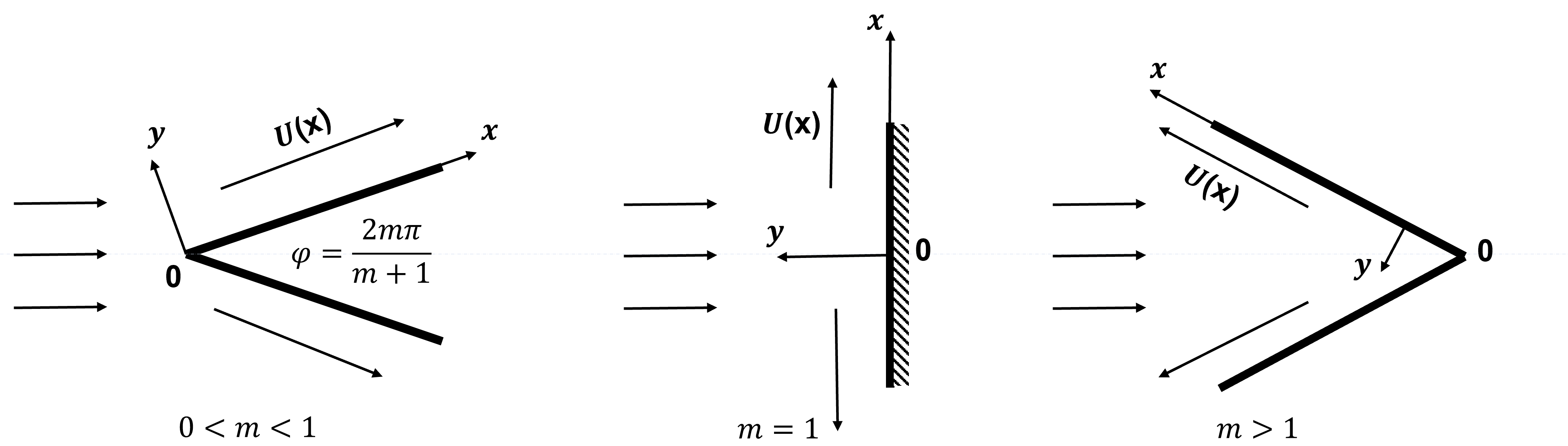
There is a lot of literature on theoretical, numerical, and experimental studies on Prandtl’s system, see [13][14] and the references therein. In particular, Oleinik and Samokhin [13] gave a systematic exposition of the main rigorous mathematical results. The main results of Oleinik and Samokhin can be summarized as that, when , there exists a unique classical solution to the problem (1.1), (1.2) for , where is small, in the class of functions having a certain behavior at infinity with respect to , namely, as , where .
It is necessary to mention the well-posedness results of the plate boundary layer equations. For the monotonic data, Oleinik and Samokhin [13] obtained the local existence of classical solutions of 2D Prandtl equations basing on the Crocco transformation. And Wang and Zhang [20] proved the global-in- regularity up to the boundary using the maximum principle technique. For non-stationary case, Xin and Zhang [22] proved the global existence of weak solutions for the favorable pressure. And then Xin, Zhang and Zhao [23] proved the global existence of smooth solutions in the case of favorable pressure gradient.
There are some results for the asymptotic behavior of the steady Prandtl equation as . Serrin [10] proved that Oleinik’s solution converges to the famous Blasius solution in sense as . Iyer [15] proved the explicit decay estimates of and its derivatives when the initial data is a small localized perturbation of the Blasius profile. Wang and Zhang [21] proved that the explicit decay estimate of in sense for general initial data with exponential decay, and also proved that the decay estimates of its derivatives when the data has an additional concave assumption.
Boundary layer separation is also an important concern, and some results have been given by predecessors. The initial work belongs van Dommelen and Shen [12]. Recently in the case of adverse pressure gradient, Dalibard and Masmoudi [1] as well as Shen, Wang, and Zhang [19] justified the physical phenomenon of boundary layer separation and studied the local behavior of the solution near the separation point. The relevant results about the unsteady Prandtl equation can be found in [9][17].
The main purpose of this paper is to establish the existence and uniqueness of solutions to the problem (1.1), (1.2) for arbitrary . This generalizes the local well-posedness results for due to Oleinik[13]. Furthermore, we similarly obtain the well-posedness results to three-dimensional flow past a cone with the cone angle. In the last section, we will describe the work on the three-dimensional symmetry case in more detail.
Our main result in this paper can be stated as
Theorem 1.1.
Assume that
| (1.3) |
where . Then the initial boundary value problem (1.1),(1.2) in the domain , for some depending on and , has a unique classical solution with the following properties: for ; are bounded and continuous in ; for and ; , as ; moreover, the solution has the following property as :
| (1.4) |
where will be mentioned in the following section; and the solution has the following inequalities as :
| (1.5) |
where .
Remark 1.1.
It is easy to verify that the results in this paper can be generalized to the following situations:
| (1.6) |
It should be noted that when , as and at the stagnation point. When and , as , which is physically impossible.
Remark 1.2.
From the theorem 1.1, we note that a point , can be found as the initial location of the continuation problem for boundary layer, where and . With the help of the results of the continuation problem for boundary layer mentioned earlier, we can naturally obtain the existence of the Prandtl system (1.1), (1.2) for any in the case of favorable condition either and or . Furthermore, through the previously mentioned results, we can prove the global-in- regularity up to the boundary and obtain the asymptotic behavior of the Prandtl equation when .
We now comment on the proof of Theorem 1.1.
First, we use a generalization of the Crocco transformation:
| (1.7) |
we obtain for the following equation:
| (1.8) |
in the domain , with the boundary conditions
| (1.9) |
where
| (1.10) |
Note that the equation (1.8) is a degenerate parabolic equation. When , let , it degenerates to the following elliptic equation:
| (1.11) |
and the boundary conditions become
| (1.12) |
Second, the key point is to establish the existence and prior estimations of the solution to the problem (1.11), (1.12). Oleinik and Samokhin solve the above difficulties through the maximum principle of the elliptic equation for . This method cannot extend to the problem for . Our basic idea is to establish equivalence between a solution to the problem (1.11), (1.12) and the self-similar solution, and to use the properties of self-similar solutions to obtain the properties of this solution.
Next, we note the solution to the equation (1.11) is an approximation of the solution to the Prandtl equation (1.1) when . And we establish the existence of solutions for problem (1.8), (1.9) by the line method: replacing with the difference quotient, obtain a series of ordinary differential equations, prove the existence theorem and, passing to the limit, establish the existence of a solution to the original equation. Furthermore, we obtain prior estimates of based on the properties of .
Finally, we use the inverse change of variables (1.7) to pass from the solution of problem (1.8), (1.9) to the solutions of problem (1.1), (1.2). And then we obtain Theorem 1.1 with the help of the properties of the solution .
We finish this introduction by outlining the rest of the paper. First, in Section II, we establish the existence and uniqueness of the solution to the problem (1.11), (1.12) with the help of the self-similar solution. Based on the results in section II, we use the line method to obtain the existence and prior estimates of the solutions for problem (1.8), (1.9) and then establish the local well-posedness of solutions for the Prandtl system (1.1), (1.2) in Section III. Finally, we similarly obtain the well-posedness results to three-dimensional flow around a cone similar to the two-dimensional symmetry case in Section IV.
2 Self-similar solutions
In the analysis of differential equations describing actual physical processes, it is often useful to examine some special solutions, which allow us to make conclusions about the main properties of the phenomena in equation. The simplest case of special solutions is that of a problem with the so-called property of self-similarity. A characteristic feature of self-similar problems of the boundary layer theory is that velocity component profiles for the flow in this case form a family of homothetic curves.
Assume and satisfy the condition (1.3), consider has the form
| (2.1) |
where . And we can obtain the following differential equation:
| (2.2) |
where , with the boundary conditions
| (2.3) |
Introduce new variable in (2.2), we obtain the following equation for :
| (2.4) |
with the boundary conditions
| (2.5) |
This is exactly the equation (1.8), (1.9) mentioned earlier.
When , we can obtain has the following self-similarity form:
| (2.6) |
where and satisfies the following equation:
| (2.7) |
with the boundary conditions
| (2.8) |
Introduce new variable in (2.7), we obtain the following equation for :
| (2.9) |
and the boundary conditions become
| (2.10) |
This is exactly the equation (1.11), (1.12) mentioned earlier. It is easy to see that the solution is an approximation of the solution when , since as .
The special case of equation (2.11), in which the wedge reduces to a flat plate, was solved numerically by Blasius (1908 [2]). And the case , which describes the three-dimensional flow of a viscous fluid against a plane wall or the planar flow of a viscous fluid against a wedge with , was solved by Homann(1936 [8]). Weyl(1942 [18]) gave rigorous proof of the solubility of the boundary-value problem (2.11) and (2.12) for any non-negative constant . He showed that the problem has a solution whose first derivative increases with and whose second derivative decreases and tends to zero as . Coppel(1959 [3]) simplified Weyl’s approach to studying the equation from the standpoint of the theory of differential equations. Schlichting(1968 [14]) and Hartman(1964 [6], 1972 [7]) have investigated the boundary value problem (2.11), (2.12) by using numerical and analytical methods. Wang, Gao, and Zhang (1998 [11]) presented a new approach to studying the problem (2.11), (2.12) and provided some new information about a normal solution to the problem.
Next, following Hartman[6], Ch.XIV, Part II, we list several results concerning the existence, uniqueness, and asymptotic behavior of solutions to certain boundary conditions for equation (2.11).
Consider equation (2.11) with the boundary conditions
| (2.13) |
where . On solutions of problem (2.11), (2.13) we impose the following additional restriction:
| (2.14) |
Theorem 2.1.
Theorem 2.2.
Obviously, we can obtain the existence, uniqueness and asymptotic behavior of solutions for equation (2.7) similar to Theorem 2.1 and Theorem 2.2. Furthermore, we obtain these properties of solutions for equation (1.11),(1.12).
Theorem 2.3.
| (2.17) |
where , , , , for .
Proof.
The solution of equation (2.7) has the following properties:
| (2.18) |
where , . We can easily obtain is bounded from below and above for , where is sufficiently small. And we have
| (2.19) |
where . It is easy to obtain
| (2.20) |
Thus, choosing suitable , we complete the proof of the first two inequalities.
By the method in [11], it is easy to see that a solution for equation (1.11) if and only if it solves the integral equation
| (2.21) |
From this we know that
| (2.22) |
We can obtain the following properties:
| (2.23) | ||||
Now, let prove the estimates for . It follows from (1.11) that
| (2.27) |
Set . Differentiating equation (1.11) with respect to ,we obtain the following equation for :
| (2.28) |
Let us consider . We have
| (2.29) |
provided that is small enough.
It follows from the second inequality for that there is a sequence , , such that
| (2.30) | ||||
if is sufficiently large.
And we have
| (2.31) |
Therefore, for . Since as , we have for .
3 Symmetric stationary boundary
The proof of the existence of solutions for problem (1.8), (1.9) is accomplished by the line method which amounts to the construction of approximate solutions for the given problem by means of solutions of a ordinary differential equations.
Set , where . We replace (1.8), (1.9) with the system of differential equations:
| (3.1) | |||
with the conditions
| (3.2) |
Here for , and , for , is a sufficiently large constant to be chosen later and . It should be noted that when , for . Obviously, the system (3.1), (3.2) is just the system (1.11) and (1.12) when . Next, we use the solution of problem (1.11),(1.12) to proof the existence of solutions for problem (3.1),(3.2).
In what follows, , , , stand for positive constants independent of .
Lemma 3.1.
Proof.
We obtain the solution of problem (3.1), (3.2) as a limit () of solutions of the following system
| (3.4) | |||
supplemented with the conditions (3.2). We have established these result for in Theorem 2.3. we obtain a prior estimate from below by induction. Setting , we find that
| (3.5) |
for and . Setting , we obtain
| (3.6) |
provided that is sufficiently small. Set . Then we have
| (3.7) |
This inequalities imply that and , since and .
Consider the system (3.4) with the boundary conditions:
| (3.8) |
where is an infinitely differentiable function defined for and such that for , for and for .
For a solution of problem (3.4), (3.8), we have . Indeed, let . Then
| (3.9) |
because of the choice of , and
| (3.10) |
The existence of solutions for problem (3.4), (3.8) for can be established by the well-known method based on the Leray-Schauder theorem.
Theorem 3.1.
(Leray-Schauder) In a Banach space , consider a family of mappings , where , is a real parameter varying on the segment .
Assume that:
1) is defined for all and ;
2) for any fixed , the operator is continuous on , i.e., for any and any , there is a constant such that , provided that ;
3) on bounded subsets of , the operators are uniformly continuous with respect to , i.e., for any bounded set and any , there is a constant such that for and , we have ;
4) for any fixed is a compact operator, i.e, it maps each bounded subset of into a compact subset of ;
5) there exists a constant such that for any solution of the equation , we have ;
6) the equation has a unique solution in .
Then the equation admits a solution in .
Consider the following system of differential equations depending on a parameter :
| (3.11) |
together with the boundary conditions
| (3.12) |
where
| (3.13) |
Let us verify the conditions of the Leray-Schauder theorem 3.1 for this system. Consider the operator which maps any vector valued function of class into , where is a solution of the following linear system of differential equations:
| (3.14) |
with the boundary conditions
| (3.15) |
For , problem (3.14), (3.15) admits a unique solution, which follows from the fact that the problem is linear, the coefficient of in (3.14) is negative, and for .
The solutions of the problem (3.11), (3.12) are uniformly (with respect to ) bounded, together with their second derivatives. We have
| (3.16) |
provided that is small enough and is independent of . Hence, for , we obtain
| (3.17) |
which readily imply that and for all , .
Let . Choosing suitably large, we obtain
| (3.18) |
where , and the boundary conditions
| (3.19) |
where . Indeed, we have
| (3.20) | ||||
By the maximum principle, it easily follows that is bounded uniformly in .
The estimate for the derivatives , uniform in , follows from the first order equations obtained from (3.11) for the function , as well as from the estimate for at obtained from (3.12). Indeed, it follows from (3.11), for , that
| (3.21) |
Let
| (3.22) |
and we can obtain
| (3.23) |
we have
| (3.24) |
Hence, .
The derivatives are found from (3.11), since we have
| (3.25) |
According to the well-known estimates of Schauder type (see Gilbarg and Trudinger [4]), we can estimate (uniformly in ) the norm of solution to problem (3.14), (3.15). The constant in this estimates depends on the norm of .
It follows that the operator maps a bounded set formed by functions in into a compact set formed by in . The continuity properties of required by the Leray-Schauder theorem follow from the continuity of the conditions that hold for the difference of the solutions of problem (3.14), (3.15) for different and , as well as from the estimates, which hold uniformly with respect to , for these solutions and their derivatives.
Thus, the existence of a solution for problem (3.4), (3.8) with is a consequence of the Leray-Schauder theorem.
Now, for these solutions, let us prove uniform estimates from above. Set . For , we can take any constant such that and for . We have
for , provided that is suitably large and independent of . Further, we have
| (3.26) |
if and is chosen sufficiently large. The difference satisfies the inequalities
| (3.27) |
These inequalities readily imply that and for and , since and .
From equations (3.4) and the boundary conditions (3.2) for , in combination with the two-sided estimates for , we obtain estimates for which hold on any segment , uniformly with respect to . Differentiating equation (3.4) with respect to , we can show that the derivatives of up to any given order are bounded on the segment , uniformly with respect to .
Consequently, from the family of solutions of problem (3.4), (3.2) depending on the parameter , , we can extract a sequence such that , together with their derivatives of any given order, are uniformly convergent on the segment , as . Obviously, the estimates (3.3) hold for the limit functions . Further the limit function is continuous on , it vanishes for and satisfies (3.1), (3.2).
Lemma 3.2.
Proof.
The inequalities will be prove by induction. We have established these inequalities for in Theorem 2.3. Let us show that there exist constants such that these inequalities being valid for imply their validity for , if and is independent of . Set
| (3.29) |
Then
| (3.30) | ||||
for , , where is sufficiently large and independent of .
Setting , we obtain
| (3.31) | ||||
if and is sufficiently large.
Consider the functions . we have
| (3.32) |
for , . We also have
| (3.33) |
for . And we have
| (3.34) |
Since the coefficients of in (3.32) and (3.33) are negative for , we can obtain , i.e. for and . In a similar way we show that
| (3.35) |
for and , where is sufficiently large and independent of .
Set
| (3.36) |
Let us write out the equations for and , . Differentiating (3.1) with respect to , we get
| (3.37) | ||||
From the boundary condition (3.2) we get
| (3.38) |
Subtracting from the equation (3.1) for that for and dividing the result by , we obtain
| (3.39) | ||||
Similarly, from (3.2) we obtain
| (3.40) |
Let us introduce the following functions:
| (3.41) | ||||
Setting , we find that
| (3.42) | ||||
And we have
| (3.43) |
for , provided and is sufficiently large and does not depend on . This is possible, since
| (3.44) |
Let us calculate . We have
| (3.45) |
where is a positive constant. It is easy to see that
| (3.46) |
if and is sufficiently large and does not depend on .
Consider the functions . We have
| (3.47) | ||||
for , if . We also have
| (3.48) |
if . And we have
| (3.49) | ||||
for . Since the coefficients of in (3.47) and (3.48) are negative for , we can obtain , i.e. for and .
Let us estimate when . Setting , we find that
| (3.50) | ||||
Where
| (3.51) |
It follows that . And we have
Then for and , where is sufficiently small, if is chosen large enough.
It follows the first inequality of (3.28) that there exist sequences such that
| (3.52) |
Let . Consider the function . Then we have . It is easy to see that
| (3.53) |
for large enough .
For , the function satisfies the following relation:
| (3.54) | ||||
We see that the coefficient of is negative since
| (3.55) |
We need to choose large enough when . Therefore , i.e. , for , since as . In a similar way, we show that
| (3.56) |
for and , where is sufficiently large and independent of .
Next, let us estimate when . Setting , we find that
| (3.57) | ||||
for , provided that is suitably large. Let us choose to be independent of and such that for , and moreover, for .
For the difference , , we obtain the following inequality
| (3.58) | ||||
Moreover,
| (3.59) |
The coefficient of is equal to
Therefore , i.e. , for , since as .
Now, let us estimate from above. It follows from (3.1) that
| (3.60) |
Therefore, it is easy to obtain is bounded from above for by the Gronwall theorem, as well as from the estimate for at obtained from the boundary condition (3.2). This is possible, since
| (3.61) | ||||
where we have
| (3.62) |
Next, let us estimate from above in the neighborhood of . Setting , we obtain the following inequality
for and , provide that and are sufficiently small ( and are independent of ).
Consider the difference . For and , the function satisfies the following inequalities
| (3.63) | ||||
Note the coefficient of is negative. Then , i.e. , for , since as . Choosing suitable , we have , for and .
It follows from (3.1) that
| (3.64) |
And we have
| (3.65) | ||||
for and , where is sufficiently small. Thus, in order to complete the proof, it suffices to take .
Next, on the basis of Lemma 3.2, we establish the following existence theorem the problem (1.8), (1.9).
Theorem 3.2.
Proof.
The functions defined as solutions of system (3.1), (3.2) can be extended in for as linear functions. Thus we obtain a family such that
| (3.67) | ||||
According to Lemma 3.2, the functions from this family satisfy the Lipschitz condition with respect to and, for , , have uniformly (in ) bounded first derivative in . By the Arzelà theorem, there is a sequence such that uniformly converge, on the rectangle , to some . Since , the sequence can be chosen to be uniformly convergent to in .
It follows from (3.28) that has bounded weak derivatives and that is bounded in . The sequence may be assumed such that the derivatives in the domain
coincide with weak limits in of the respective functions
Let us show that equation (1.8) holds for everywhere in . By construction, the function satisfies the equation (3.1), i.e.,
| (3.68) | |||
Let be an infinitely differentiable function with compact support strictly inside . Multiplying (3.68) by , integrating the resulting equation in from to , and taking the sum over from to , we obtain
| (3.69) |
Denote by a function defined in and equal to for . Using this notation, we can rewrite (3.69) in the form
| (3.70) |
The functions are uniformly convergent to , respectively, as .
For any , the functions are weakly convergent in to , respectively, as . Passing to the limit as in (3.70), we find that
| (3.71) |
which implies, owing to our choice of , that equation (1.8) holds almost everywhere for in .
It follows from (1.8) that the function and its derivatives in (1.8) satisfy the Hölder condition in any domain strictly interior to , since the Lipschitz condition holds for and .
Let us show that the boundary conditions (1.9) are also satisfied. The validity of the first condition follows from the uniform convergence of and (3.2) for . Set
| (3.72) |
Since , for , is bounded uniformly in and the second boundary condition in (3.2) is satisfied, we have
| (3.73) |
The function is a weak limit in of as . Therefore, , which means that the boundary condition (1.9) is satisfied.
Next, let us prove the uniqueness of the solution. Assume that problem (1.8), (1.9) in admits two solutions, say , with the above properties. Set . Then
| (3.74) |
We have
| (3.75) | ||||
for when , since
| (3.76) |
And we have
| (3.77) |
for as .
Therefore, can have neither a positive maximum nor a negative minimum. Consequently, , .
Proof.
Proof of Theorem 1.1
According to (1.7), we have
| (3.78) |
Hence, by virtue of the continuity of in and the inequality for , we see that is continuous in ,
| (3.79) |
is bounded and continuous in , for . And we find that
| (3.80) | ||||
From the properties of and its derivatives, in combination with (LABEL:rel), it follows that the generalized derivatives are bounded in , and is bounded for finite . The first inequality for follows from the estimates for . The continuity of and with respect to follows from (LABEL:rel). Let us define by
| (3.81) |
The function has the first derivative with respect to in , we obtain the equations
| (3.82) |
The function satisfies equation (1.8). Replacing the derivatives of by those of in (1.8), we find that
| (3.83) |
Let us show that satisfies the condition
| (3.86) |
It follows from (1.9) that
| (3.87) |
And we find that
| (3.88) |
It follows that the function is continuous in with respect to , and is bounded for bounded , is bounded in .
Using the estimates for established in Theorem 3.2 and those for from Theorem 2.3, we find that the following inequality is valid:
| (3.89) |
This brings us to the inequalities as
| (3.90) |
since
| (3.91) |
And we find that
| (3.92) |
and therefore
| (3.93) |
Hence we see that
| (3.94) |
If is a solution of problem (1.1),(1.2) with the properties listed in Theorem 1.1, then, changing the variables by (1.7) and introducing the function , we arrive at a solution of problem (1.8), (1.9) with the properties specified in Theorem 3.2. As shown above, the latter solution is unique.
4 Axially symmetric stationary boundary layer
In this section, we consider the following Prandtl system for the axially symmetric three-dimensional incompressible stationary flow:
| (4.1) |
in the domain with the boundary conditions
| (4.2) |
The function determines the surface of the body past which the fluid flows: , for , . is a given longitudinal velocity component of the outer flow: , for , is the viscosity coefficient.
For instance, when three-dimensional axially symmetric flow flows to a cone with the cone angle , the system mentioned above appears near the surface of the cone (cf.Figure 4.1). It is known that the Euler flow near the surface of the cone possesses the following property. The flow velocity varies according to the law , where . When, (for example, the three-dimensional flow against a plane wall). When , and when , . Perhaps, due to the curvature of the surface, lower-order terms appear in this asymptotics.
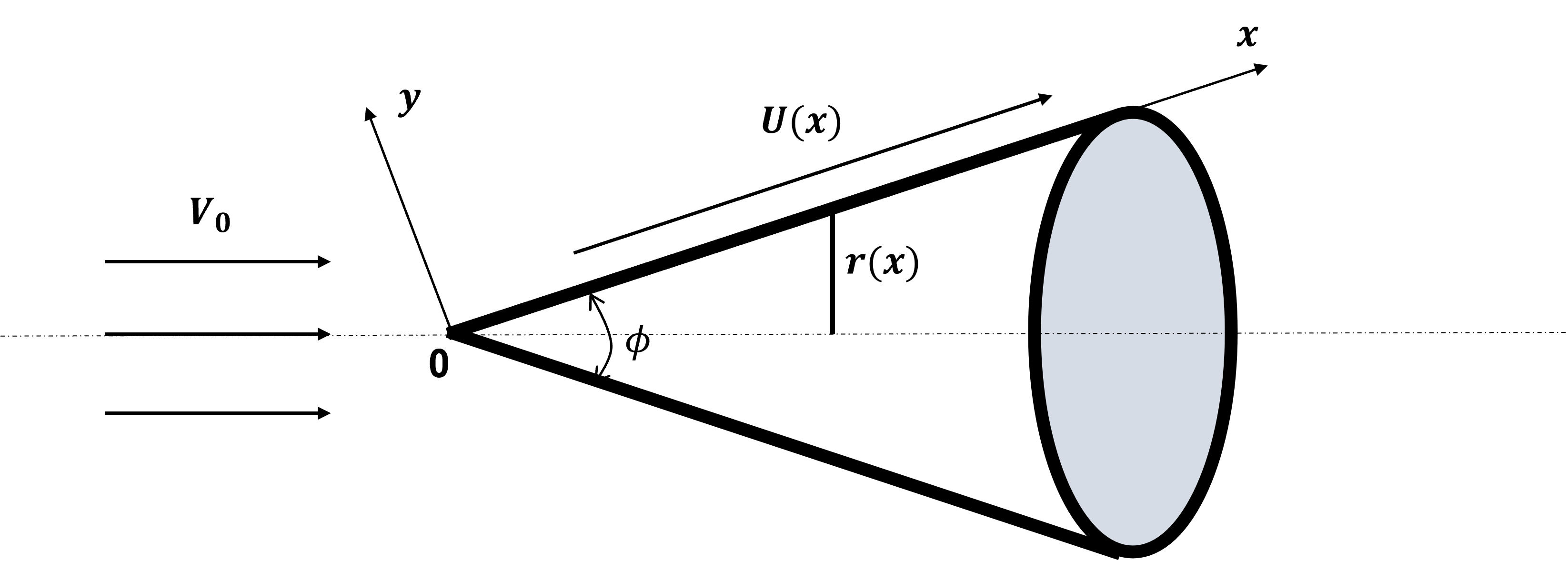
Oleinik and Samokhin considered the boundary layer problem near a critical point on the wall in the case of an axially symmetric flow in [13]. The main results of them can be summarized as that, when , there exists a unique classical solution to the problem (4.1), (4.2) for , where is small, in the class of functions having a certain behavior at infinity with respect to , namely, as , where . The main purpose of this section is to establish the existence, uniqueness, and asymptotic behavior of solutions to the system (1.1), (4.2) for arbitrary . This generalizes the local well-posedness results due to Oleinik mentioned above.
The axially symmetric stationary boundary layer problem can also be solved by the line method on the basis of the Crocco transformation. The approach of the preceding sections can be applied with no principal modifications. For this reason, we restrict ourselves to the statement of the problem and the main result.
In what follow, stand for positive constants.
Introducing a generalization of the Crocco variables
| (4.4) |
we obtain for the following equation:
| (4.5) |
in the domain , with the boundary conditions
| (4.6) |
where
| (4.7) |
When , let , the equation (4.5) degenerates to the following elliptic equation:
| (4.8) |
and the boundary conditions become
| (4.9) |
As mentioned in Section II, what we care about is the following self-similarity results.
Consider , , , has the following self-similarity form:
| (4.10) |
and satisfies the following equation
| (4.11) |
with the boundary conditions
| (4.12) |
Furthermore, introduce , , we can obtain the equation (4.8), (4.9).
Obviously, we can obtain the existence, uniqueness and asymptotic behavior of solutions for equation (4.11) similar to Theorem 2.1 and Theorem 2.2. Furthermore, we can establish the following result.
Theorem 4.1.
Similar to Section III, we obtain the following existence theorem for the problem (4.5), (4.6) by the line method.
Theorem 4.2.
Theorem 4.3.
Let , , and satisfy the conditions (4.3). Then the initial boundary value problem (4.1),(4.2) in the domain , for some depending on , and , has a unique classical solution with the following properties: for ; are bounded and continuous in ; for and ; , as ; moreover, the solution has the following property as :
| (4.15) |
where satisfies equation (4.11); and the solution has the following inequalities as :
| (4.16) |
Remark 4.1.
From the theorem 4.3, we note that a point , can be found as the initial location of the continuation problem for axially symmetric boundary layer, where and . Consider the system:
| (4.17) |
in the domain with the boundary conditions
| (4.18) |
In order to solve this continuation problem by the line method on the basis of the Crocco transformation, the approach of continuation of the boundary layer (see Oleinik and Samokhin [13]) can be applied with no principal modifications. Thus we can naturally obtain the existence of the Prandtl system (4.1), (4.2) for any in the case of favorable condition either and or , and .
Acknowledgement.
L. Zhang is supported by NSFC under grant No.12031012 and National Key RD Program of China, Grant No.2021YFA1000800. C. Zhao is supported by National Key RD Program of China, Grant No.2021YFA1000800.
References
- [1] A. Dalibard and N. Masmoudi. Separation for the stationary Prandtl equation, Publ. Math. Inst. Hautes Etudes Sci., 130 (2019), 187-297.
- [2] Blasius.H. Grenzschichten in Flissigkeiten mit kleiner Reibung. Z. Math. Phys.(1908) 56, 1-37.
- [3] Coppel.W.A. On a differential equation of boundary-layer theory. Philos. Trans. Roy. Soc. London Ser. A 253 (1960), 101–136.
- [4] D.Gilbarg, N.Trudinger. Elliptic partial differential equations of second order. Reprint of the 1998 edition. Classics in Mathematics. Springer-Verlag, Berlin, 2001. xiv+517 pp. ISBN: 3-540-41160-7 35-02(35Jxx)
- [5] D.J.Acheson. “Elementary Fluid Dynamics,” Clarendon Press, Oxford, 1990.
- [6] Hartman.P. Ordinary differential equations. John Wiley & Sons, Inc., New York-London-Sydney 1964 xiv+612 pp.
- [7] Hartman.P. On the existence of similar solutions of some boundary layer problems. SIAM J. Math. Anal.3 (1972), 120–147.
- [8] Homann.F. Einfluss grosser Zahigkeit bei Stromung um Zylinder und Kugel. Z.angew.Math.Mech.(1936) 16, 153-164
- [9] I.Kukavica, V.Vicol and F.Wang. The van Dommelen and shen singularity in the Prandtl equtions, Adv. Math. 307 (2017) 288–311.
- [10] J. Serrin, Asymptotic behavior of velocity profiles in the Prandtl boundary layer theory, Proc. R. Soc. Lond. A, 299(1967), 491-507.
- [11] J.Wang, W.Gao, Z.Zhang. Singular nonlinear boundary value problems arising in boundary layer theory. J.Math.Anal.Appl.233 (1999), no.1, 246–256.
- [12] L.L.van Dommelen and S.F.Shen. The spontaneous generation of the singularity in a separating laminar boundary layer, J.Comput. Phys. 38, 1980, pp. 125–140.
- [13] Oleinik.O.A, Samokhin.V.N. Mathematical models in boundary layer theory.Applied Mathematics and Mathematical Computation, 15. Chapman & Hall/CRC, Boca Raton, FL, 1999. x+516 pp. ISBN: 1-58488-015-5 76D10 (35Q35 76D03 76M20)
- [14] Schlichting.H. Boundary-layer Theory, Ninth ed.Springer-Verlag Berlin Heidelberg 2017.
- [15] S.Iyer. On global-in- stability of Blasius profiles, Arch. Rational Mech. Anal., 237(2020), 951-998.
- [16] V.M.Falkner and S.W.Skan. Some approximate solutions of the boundary layer equations, Phil. Msg. 12, 865-896, (1931); ARC RM1314, (1930).
- [17] Weinan.E and B.Engquist. Blowup of solutions of the unsteady Prandtl’s equation, Commun. Pure Appl.Math. 50 (1997) 1287–1293.
- [18] Weyl.H. On the differential equations of the simplest boundary-layer problems. Ann. of Math. (2) 43 (1942), 381–407.
- [19] W.Shen, Y.Wang and Z.Zhang. Boundary Layer Separation and Local behavior for the steady Prandtl equation, Adv. Math., 389 (2021), Paper No. 107896.
- [20] Y.Wang and Z.Zhang. Global regularity of the steady Prandtl equation with favorable pressure gradient, Ann. Inst. H. Poincaré C Anal. Non Linéaire 38(2021), no. 6, 1989-2004. 35Q35
- [21] Y.Wang and Z.Zhang. Asymptotic Behavior of the Steady Prandtl Equation, arXiv:2109.02848.
- [22] Z.Xin and L.Zhang. On the global existence of solutions to the Prandtl system. Adv. Math., 181 (2004),88-133
- [23] Z.Xin, L.Zhang and J.Zhao. Global Well-posedness and Regularity of Weak Solutions to the Prandtl’s System, arXiv:2203.08988.