Hadron-quark transition and chiral symmetry restoration at high density
Abstract
A simple phenomenological hybrid hadron-quark model with effective volume effects of baryons and chiral dynamics is investigated. The hybrid EoS naturally connects the low-density baryonic matter with the high-density quark matter. In the intermediate region, a phase, which cannot be regarded as pure hadron matter or pure quark matter, appears. In this model, there is a possibility that the abrupt first-order-like transition to pure quark matter induces the strong chiral symmetry restoration and the speed of sound has a large peak at considerable large density.
I Introduction
Exploration of the QCD phase diagram is an important subject not only in particle and nuclear physics but also in astrophysics and cosmology; for a review, see, e.g., Ref. Fukushima and Hatsuda (2011) and references therein. However, at finite baryon (or quark) chemical potential, the first principle calculation, i.e., the lattice QCD simulation, is not feasible due to the infamous sign problem. To avoid the problem, several methods are proposed and investigated, but, at present, these methods are not complete, and we do not have the established equation of state (EoS) at finite baryon density.
At low temperature, there is nuclear (baryonic) matter at saturation density. As the density increases, other baryons may appear. At the extreme high density, the chiral symmetric quark matter is expected to appear and conformality is restored. However, at present, we do not have a definite information of the EoS in the intermediate region between the saturation density and the extremely high density.
It is known that repulsive effects among baryons are important in the intermediate region. If repulsion is absent, the baryonic matter is realized at sufficiently large baryon density Cleymans et al. (1986a). One of the traditional treatments of such repulsion is to consider the excluded volume effects (EVE) among baryons Cleymans et al. (1986b); Kouno and Takagi (1989); Rischke et al. (1991). The excluded volume effects successfully prevent baryonic matter from realizing at sufficiently large baryon density; for a recent review, see, e.g., Ref. Fujimoto et al. (2022a) and references therein.
At large density, the chiral symmetry restoration is also expected. The Nambu–Jona-Lasinio (NJL) model Nambu and Jona-Lasinio (1961a); *Nambu:1961fr is a simple but very useful model to describe the restoration; as a review, see, e.g., Ref. Hatsuda and Kunihiro (1994) and references therein. However, the NJL model cannot describe the hadron-quark transition.
Furthermore, recently, it has been emphasized that the trace anomaly and the speed of sound are very important to understand the properties of the high density hadron and quark matter; see, e.g., Refs. Fujimoto et al. (2022b); Kojo (2021a) and references therein.
In this paper, we construct a simple phenomenological hybrid hadron-quark model with EVE of baryons and chiral dynamics. The model naturally connects the baryonic matter at low density and the quark matter at high density. It can also describe the chiral restoration. It is found that, in this hybrid model, there is a possibility that the abrupt first-order like transition to pure quark matter induces the strong restoration of chiral symmetry and the speed of sound has a large peak.
II Formalism
First, we give a sketch of our strategy of calculations. Our main purpose is to know the -dependence of the thermodynamic quantities of hadron or quark matter, where is the baryon chemical potential. First, we construct the baryon number density with the EVE of baryons. Next we require that approaches in the high density limit, where is the quark number density of pure quark phase. In this procedure, depends on the chiral condensates which are included in the quark model. Using the thermodynamic equation, the -dependence of the thermodynamic potential density is obtained, where is the pressure of the system. The values of are determined to minimize (or maximize ). Using the obtained values of , the other thermodynamic quantities are calculated.
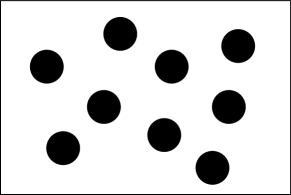
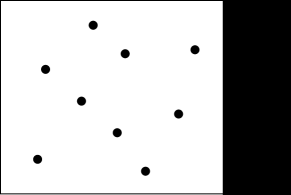
As shown in Fig. 1, we consider non-pointlike baryons in the system with volume where is the number of baryons. We consider this system to be equivalent to the system of pointlike baryons in the effective volume where is the volume of a baryon; see Fig. 2. Then, the following equation is satisfied;
| (1) |
where is the baryon density of non-pointlike baryon and is the one of pointlike baryons. In this paper, we add a tilde to the baryon number density of point-like baryons. Hence, the baryon number density of baryonic matter with EVE is given by
| (2) |
The pressure of the baryonic matter with the excluded volume effects is determined by the thermodynamic equation
| (3) |
The other thermodynamic quantity, such as the energy density , is determined by the thermodynamic relation. Hereafter, we concentrate on EoS at zero temperature and omit the variable for simplicity. Then, Eq. (3) is represented as .
When a constant is used, the speed of sound,
| (4) |
may exceed the speed of light and the causality can be easily violated. In fact, when , we have
| (5) | |||
| (6) |
This means that the EoS becomes very hard and the speed of sound diverges. Therefore, the density dependence of is very important.
It is natural to assume that the baryon number of the system approaches the one of the pure quark system with the same chemical potential, when the baryon chemical potential is very large. This requirement can be achieved if we assume
| (7) |
where is the quark number density of the pure quark matter. In other words, we assume that EoS inside the baryons is described by the pure-quark model. The baryon number density is given by
| (8) | ||||
| (9) |
Hence, the EoS is expected to approach the pure quark EoS at high density. When , we obtain
| (10) |
When and , Eq. (9) can be rewritten as
| (11) | |||||
| (12) | |||||
| (13) |
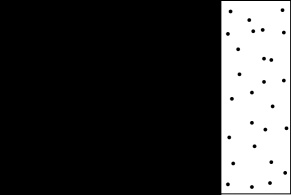
where . From Eq. (11), we see that the system can also be regarded as the matter of quarks with finite effective volume ; see Fig. 3. In this sense, this model has a quark-hadron duality; for a general review of quark-hadron duality, see, e.g., Ref. Shifman (2000) and references therein. It is also interesting that Eq. (13) resembles the law of combined resistance of parallel resistances. The large causes the strong suppression of baryonic matter. When , it is natural to regard that the system is composed of quarks with small volume rather than baryons with large volume .
However, when , cannot be defined. On the other side, it is known that, below the saturation density, the nucleon has a finite volume with the nucleon radius fm. Hence, we interpolate between and with the following smooth function of ;
| (14) |
with
| (15) |
where is a free parameter and controls how abruptly approaches . Note that, as is shown below, depends on chiral condensates in our model. Hence, and also depend on the chiral condensates.
For the pointlike hadron model, we use the hadron resonance gas (HRG) model. The number density is given as
| (16) |
where and are the spin degeneracy and the mass of -th baryon, respectively. The function is the number density of ideal fermion gas with the degeneracy factor , the mass and the chemical potential at zero temperature, and is given by
| (19) |
In this paper, for simplicity, we use the same for all baryons.
For pure quark matter, we use the three-flavor NJL model with mean field approximation. The quark number density of the NJL model is given by
| (20) |
where and are the effective mass of -quark and the quark chemical potential, respectively. The effective quark mass is given by
| (21) |
with , and , where is the current quark mass of -quark, and are coupling constants of four and six-quarks interaction, and is the chiral condensate of -quark, respectively. In the pure quark system, the pressure is given by
| (22) |
where , and are the Dirac sea contributions, the mesonic and the density parts of the NJL model, respectively. For each flavor, the density part is given by which is equivalent to the pressure of the free quark gas with the quark mass and the quark chemical potential . The Dirac sea contributions are given by
| (23) | |||||
where with the three dimensional momentum cutoff . The Dirac sea contributions have no explicit -dependence. However, depends on , since depends on . The mesonic part is given by
| (24) |
According to Ref. Rehberg et al. (1996), we set MeV, MeV, , and MeV.
Instead of Eq. (22), in the hybrid model, the total pressure of the system is given by
| (25) |
Using given by Eq. (2) with Eq. (14), the density part is given by
| (26) |
where the integration is performed with fixing all so as to satisfy the relation
| (27) |
The value of the chiral condensate is determined to maximize and satisfy
| (28) |
Hence, the thermodynamic relation
| (29) | |||||
is satisfied. Therefore, using Eq. (26), once is obtained as the function of and the solution which maximizes the total pressure (25) is determined, the equation of motion (28) and the thermodynamic relation (29) are automatically satisfied. The energy density of the total system is determined using the thermodynamic relation
| (30) |
Following the above procedure, the quark and hadron matters are correlated with each other in the level of the pressure via EVE. This is also true for the thermodynamic potential density because there is a direct relation to the pressure, namely . The functional form of deviates largely from the one in the original NJL model in the intermediate region of . Therefore, our result can provide the crossover behavior even if the NJL model itself has the first-order chiral transition at low in the moderately high density region; since the thermodynamic potential is deformed by the hadron contributions, they act as the external term that explicitly breaks chiral symmetry.
The hybrid model approaches in the NJL model in the high density limit. As is seen in the next section, when approaches gradually, crossover chiral transition takes place. When approaches abruptly, first-order like transition happens.
The original NJL model has a cutoff. However, at zero temperature, the chemical potential is the natural cutoff for energy and momentum. Hence, in the numerical calculations, we use the cutoff only in the Dirac Sea contributions. In this procedure, the physical quantities are expected to approach those in the free quark gas model. In the HRG part, we include all baryons listed in the list of Particle Data Group Workman and Others (2022), but they only contribute to the results when their masses are smaller than the baryon chemical potential .
Several hybrid models have been already proposed. For example, in Ref. Masuda et al. (2013), the hyperbolic functions are used as an interpolation function of EoS. In our model, we do not give such an interpolation function but give a more microscopic quantity, namely, the density dependence of baryon volume in EVE. In Ref. Jeong et al. (2020), the hybrid model based on quarkyonic matter and the EVE is investigated. In our model, we do not assume quarkyonic matter, but some kind of more macroscopic quark-hadron duality (11) is assumed. The macroscopic model may be simpler and more convenient than the microscopic one, but it has a less dynamical description. The study of the relation between several hybrid models is an important problem in the future.
III Numerical results
Our hybrid model has one free parameter in Eq. (15). In this section, we show the numerical results in two typical cases, a crossover transition () and a first-order like transition (). Hereafter, we use the quark chemical potential instead of since we are interested in the chiral dynamics of quarks as well as the hadron-quark transition.
The numerical calculations are done according to the following procedures.
(1) For given , is calculated using the HRG model.
(2) For fixed value of , is calculated.
(3) Using and as inputs, is calculated as an output.
(4) Using Eq. (26) and , () is calculated for the fixed value of .
(5) Changing the value of and doing the same calculation as the procedure (2)(4), a functional form () is determined.
(6) Determine the solution which minimizes (maximizes ).
(7) Using the obtained solution , the other quantities are calculated as well as and .
Note that the equation of motion (28) and the thermodynamic relation (29) are automatically satisfied by minimizing (maximizing) ().
III.1 Crossover transition
First, we show the results with ; in the following, we call it the crossover setup. Figure 4 shows the -dependence of the baryon number density . Note that not only but also depends on the values of the chiral condensates determined in the framework of the hybrid model. We see that coincides with at low density and, at GeV, begins to deviate from . As increases, approaches smoothly. Although the hadron-quark transition is a smooth crossover, we can regard the system as in the quark phase when GeV. In the intermediate region GeV, it is difficult to identify the system as pure hadron matter or pure quark matter.
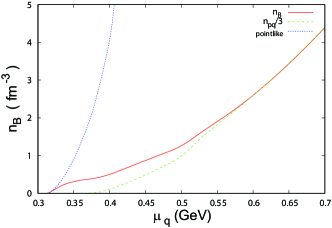
Figure 5 shows the -dependence of the baryon volume . We see that approaches smoothly as increases. When GeV, is smaller than . Hence we may regard the system to be composed of quarks rather than baryons when GeV.
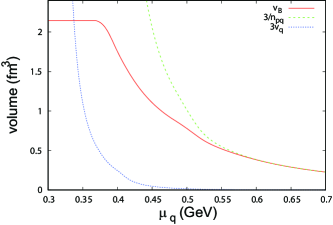
Figure 6 shows the -dependence of the effective quark mass . We see that starts to decrease when exceeds the value of the effective light-quark mass at vacuum and gradually decreases as increases. somewhat decreases early when exceeds GeV. Comparing Fig. 5 and Fig. 6, we see that decreases early when is negligible.
With the crossover setup, the hybrid model approaches the NJL model gradually as increases. Figure 7 shows the -dependence of the thermodynamic potential . We see that the value of in the minimum of decreases only slowly.
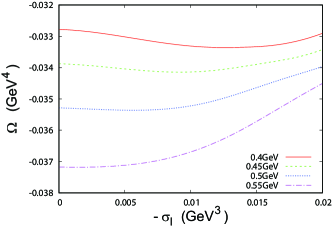
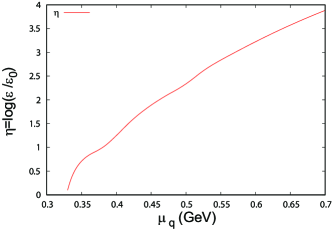
Figure 8 shows the - relation. Since and have the Dirac sea contributions which are not zero even at , we subtract and from and , respectively. We see that increases monotonically as increases. The intermediate phase mentioned above exists in the region GeV/fm3.
According to Ref. Fujimoto et al. (2022b), we introduce the following quantities,
| (31) |
where , and
| (32) |
When vanishes, the trace anomaly becomes zero and the conformality is expected to be hold. Figure 9 shows the -dependence of . increases monotonically as increases. The intermediate region GeV corresponds to the region .
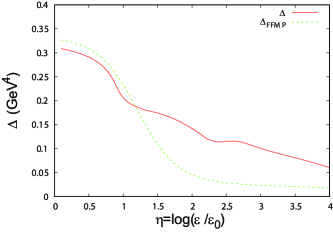
The solid line in Fig. 10 shows the -dependence of obtained by our hybrid model. The dashed line shows the result obtained by parameterization in Ref. Fujimoto et al. (2022b),
| (33) |
where , , and . In this paper, we call this parameterization . Our result is in good agreement with when , but somewhat deviates from at large .
Using and , the square of the speed of sound is rewritten as Fujimoto et al. (2022b)
| (34) |
where the derivative and non-derivative parts are given by
| (35) |
Figure 11 shows the -dependence of . has a double peak structure and, in the region , somewhat deviates from the parameterization result. The left peak is higher than the right one. It seems that the left peak is induced by the repulsion forces (i.e., excluded volume effects) among baryons, and the right one is related to the hadron-quark transition and the enhancement of the chiral symmetry restoration. It seems that this structure of corresponds to the right sketch in Fig. 2 in Ref. Kojo (2021a).
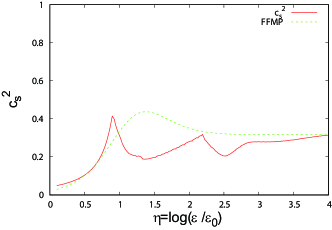
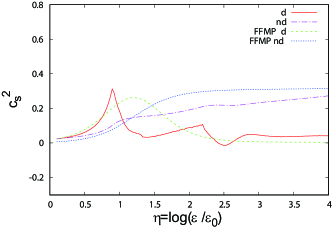
Figure 12 shows the -dependence of and . It seems that the double peaks are originated in the derivative part. At large , and somewhat deviate from the parameterization results, but the deviations cancel each other, and the total is in good agreement with the parameterization.
III.2 First-order like transition
Next, we show the results with ; in the following, we call it the first-order like setup. Figure 13 shows the -dependence of the baryon number density . We can see that coincides with at low density. As increases, approaches . Finally, coincides with at GeV, and increases rapidly. In this case, it seems that the first-order-like transition occurs at GeV. It is clear that the system is in a pure quark phase when GeV. However, it seems that the system is in the intermediate phase rather than in the hadron phase in the region GeV.
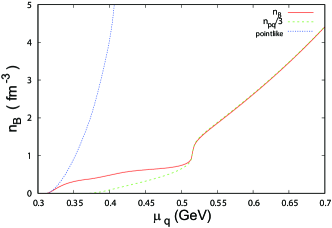
Figure 14 shows the -dependence of the baryon volume . We see that coincides with at GeV and decreases rapidly. When GeV, is smaller than . Hence, it is natural to regard that the system is composed of quarks rather than baryons even when GeV, although it is not in the pure quark phase.
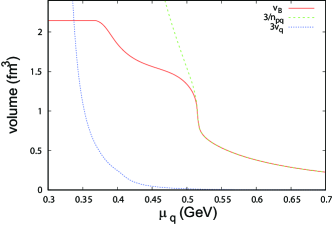
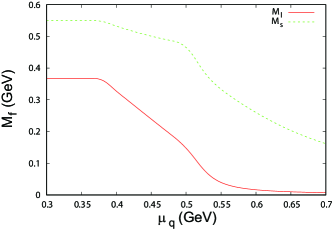
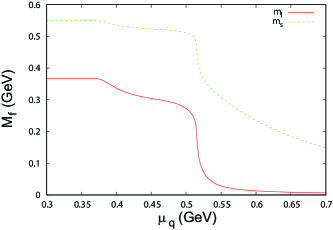
Figure 15 shows the -dependence of the effective quark mass . We see that starts to decrease when exceeds the value of the effective light quark mass at vacuum, gradually decreases as increases, and then has an abrupt decrease at GeV. The abrupt restoration of the chiral symmetry occurs at GeV. It seems that this abrupt restoration of chiral symmetry is related to the abrupt increase of . It is known that in an abrupt transition, different physical quantities are correlated to each other near the transition point Barducci et al. (1993); Kashiwa et al. (2009); Sakai et al. (2010). Hence, in this hybrid model, the abrupt changes in and are correlated with each other.
With the first-order like setup, the hybrid model approaches the NJL model abruptly as increases. Figure 16 shows the -dependence of the thermodynamic potential . We see that the value of in the minimum of decreases rapidly. It should be noted that the bottom of is almost flat at GeV.
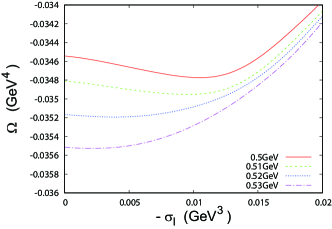
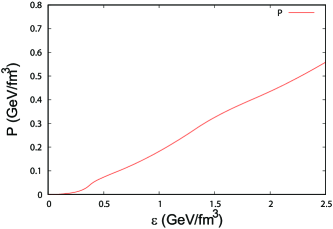
Figure 17 shows the - relation. We see that increases monotonically as increases when or . There is a plateau of in the region . This plateau is induced by the first-order like transition. The intermediate phase exists in the region GeV/fm3.
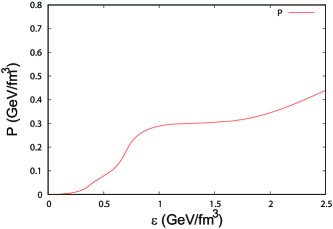
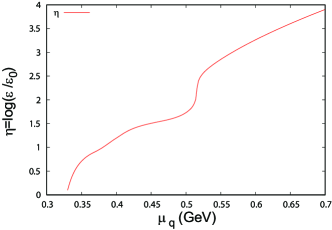
Figure 18 shows the -dependence of . There is the tendency that increases monotonically as increases and has an abrupt increase at GeV. The intermediate region GeV corresponds to the region .
The solid line in Fig. 19 shows the -dependence of in our hybrid model. Our result of is in good agreement with , where means the result obtained by parameterization (7) in Ref. Fujimoto et al. (2022b), when , but somewhat deviate from at large .
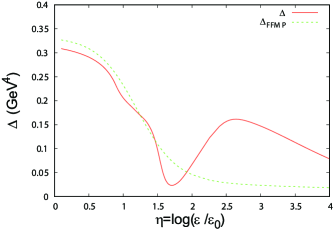
Figure 20 shows the -dependence of . We can see that has a double peak structure and, in the region , somewhat deviates from the parameterization result. In contrast to Fig. 11, the right peak is higher than the left one. It seems that the left peak is induced by the repulsion forces among baryons and that the right peak is related to the hadron-quark transition and the chiral symmetry restoration.
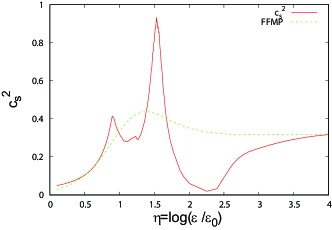
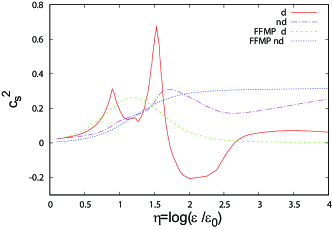
Figure 21 shows the -dependence of and . It seems that the double peaks are originated in the derivative part. As in the case of Fig. 12, and somewhat deviate from parameterization results at large , but the deviations cancel each other and the total is in good agreement with the parameterization. It seems that this structure of corresponds to the left sketch in Fig. 2 in Ref. Kojo (2021a).
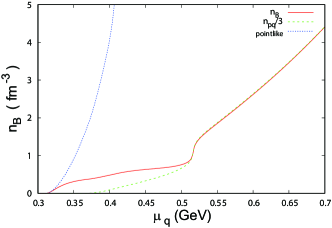
It should be noted that the baryon number density has one to one correspondence to the other thermodynamic quantities since we only use the thermodynamic relations to calculate these quantities. Hence, the -dependence of the baryon number density is strongly correlated with the -dependence of the other thermodynamic quantities. Figure 22 shows the -dependence of the baryon number density when the baryon volume
| (36) |
with
| (37) |
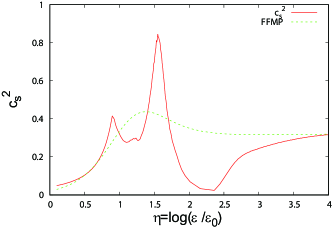
is used instead of Eqs. (14). Figure 22 resembles Fig. 13. Figure 23 shows the -dependence of the speed of sound. We see that Fig. 23 also resembles Fig. 20. In this meaning, the qualitative properties of the thermodynamic quantities do not depend on the detailed description of .
IV Summary
In summary, in this paper, the simple phenomenological hybrid model with the excluded volume effect (EVE) of baryons and the chiral dynamics is investigated. In the model, we combine the Nambu–Jona-Lasinio model and the hadron resonance gas model. The model interpolates between nuclear matter at saturation density and quark matter at high density. The equation of state (EoS) approaches that of pure quark matter as the density increases. There is the intermediate phase, which is difficult to be identified as a pure hadron phase or a pure quark phase. The speed of sound has a double-peak structure. One peak is related to the EVE of baryons, and the other is related to the hadron-quark transition and the chiral symmetry restoration. If the baryon volume approaches gradually, the hadron-quark transition is a typical crossover transition, where is the quark number density of the pure quark phase. If the baryon volume approaches abruptly, the first-order like transition can occur in cooperation with the rapid chiral symmetry restoration, and the speed of sound can be very large.
It seems that the density dependence of the baryon volume is very important for EoS at zero temperature. It is desirable to determine the dependence in the framework of the lattice QCD simulation. Simulations using the imaginary baryon chemical potential de Forcrand and Philipsen (2002); D’Elia and Lombardo (2003); Nagata and Nakamura (2011); Takahashi et al. (2015) may be useful for this purpose; see Refs. Roberge and Weiss (1986); Kashiwa (2019) as an example.
It is interesting to investigate neutron star properties using our hybrid model. However, to extend the model to asymmetric matter, we should know not only the density dependence but also the isospin dependence of the baryon volume. The lattice QCD simulation with imaginary baryon and isospin chemical potentials D’Elia and Sanfilippo (2009) may be useful to determine the dependence.
Recently, repulsion in nuclear matter is discussed McLerran and Reddy (2019); Jeong et al. (2020); Duarte et al. (2020) in the context of quarkyonic matter McLerran and Pisarski (2007). In quarkyonic matter, the onset of the quark Fermi sea suppresses baryonic matter Kojo (2021b). The quarkyonic effective field theory Duarte et al. (2021, 2023) is developed and the relation between the quarkyonic phase and EVE is discussed. Although the existence of quarkyonic matter is not explicitly assumed in our simple phenomenological hybrid model, there is some kind of quark-hadron duality and an intermediate phase which cannot be identified as pure hadron matter or pure quark matter appears. The study of the relation between quarkyonic matter and baryon volume may be important.
On the thermal QCD transition, the possibility of the existence of the partial deconfinement phase has been discussed recently; for a recent review, see, e.g., Ref. Hanada and Watanabe (2023). The partial deconfinement can be regarded as the coexistence of two phases in the internal color space rather than in the coordinate space. The intermediate phase which appears in our model may also be understood as such a phase.
Acknowledgements.
K.K. is supported in part by the Grants-in-Aid for Scientific Research from JSPS (No. JP22H05112).References
- Fukushima and Hatsuda (2011) K. Fukushima and T. Hatsuda, Rept. Prog. Phys. 74, 014001 (2011), arXiv:1005.4814 [hep-ph] .
- Cleymans et al. (1986a) J. Cleymans, R. V. Gavai, and E. Suhonen, Phys. Rept. 130, 217 (1986a).
- Cleymans et al. (1986b) J. Cleymans, K. Redlich, H. Satz, and E. Suhonen, Z. Phys. C 33, 151 (1986b).
- Kouno and Takagi (1989) H. Kouno and F. Takagi, Z. Phys. C 42, 209 (1989).
- Rischke et al. (1991) D. H. Rischke, M. I. Gorenstein, H. Stoecker, and W. Greiner, Z. Phys. C 51, 485 (1991).
- Fujimoto et al. (2022a) Y. Fujimoto, K. Fukushima, Y. Hidaka, A. Hiraguchi, and K. Iida, Phys. Lett. B 835, 137524 (2022a), arXiv:2109.06799 [nucl-th] .
- Nambu and Jona-Lasinio (1961a) Y. Nambu and G. Jona-Lasinio, Phys. Rev. 122, 345 (1961a).
- Nambu and Jona-Lasinio (1961b) Y. Nambu and G. Jona-Lasinio, Phys. Rev. 124, 246 (1961b).
- Hatsuda and Kunihiro (1994) T. Hatsuda and T. Kunihiro, Phys. Rept. 247, 221 (1994), arXiv:hep-ph/9401310 .
- Fujimoto et al. (2022b) Y. Fujimoto, K. Fukushima, L. D. McLerran, and M. Praszalowicz, Phys. Rev. Lett. 129, 252702 (2022b), arXiv:2207.06753 [nucl-th] .
- Kojo (2021a) T. Kojo, AAPPS Bull. 31, 11 (2021a), arXiv:2011.10940 [nucl-th] .
- Shifman (2000) M. A. Shifman, in 8th International Symposium on Heavy Flavor Physics, Vol. 3 (World Scientific, Singapore, 2000) pp. 1447–1494, arXiv:hep-ph/0009131 .
- Rehberg et al. (1996) P. Rehberg, S. P. Klevansky, and J. Hufner, Phys. Rev. C 53, 410 (1996), arXiv:hep-ph/9506436 .
- Workman and Others (2022) R. L. Workman and Others (Particle Data Group), PTEP 2022, 083C01 (2022).
- Masuda et al. (2013) K. Masuda, T. Hatsuda, and T. Takatsuka, PTEP 2013, 073D01 (2013), arXiv:1212.6803 [nucl-th] .
- Jeong et al. (2020) K. S. Jeong, L. McLerran, and S. Sen, Phys. Rev. C 101, 035201 (2020), arXiv:1908.04799 [nucl-th] .
- Barducci et al. (1993) A. Barducci, R. Casalbuoni, G. Pettini, and R. Gatto, Phys. Lett. B 301, 95 (1993), arXiv:hep-ph/9212276 .
- Kashiwa et al. (2009) K. Kashiwa, M. Yahiro, H. Kouno, M. Matsuzaki, Y. Sakai, H. Kouno, M. Matsuzaki, and M. Yahiro, J. Phys. G 36, 105001 (2009), arXiv:0804.3557 [hep-ph] .
- Sakai et al. (2010) Y. Sakai, T. Sasaki, H. Kouno, and M. Yahiro, Phys. Rev. D 82, 076003 (2010), arXiv:1006.3648 [hep-ph] .
- de Forcrand and Philipsen (2002) P. de Forcrand and O. Philipsen, Nucl. Phys. B 642, 290 (2002), arXiv:hep-lat/0205016 .
- D’Elia and Lombardo (2003) M. D’Elia and M.-P. Lombardo, Phys. Rev. D 67, 014505 (2003), arXiv:hep-lat/0209146 .
- Nagata and Nakamura (2011) K. Nagata and A. Nakamura, Phys. Rev. D 83, 114507 (2011), arXiv:1104.2142 [hep-lat] .
- Takahashi et al. (2015) J. Takahashi, H. Kouno, and M. Yahiro, Phys. Rev. D 91, 014501 (2015), arXiv:1410.7518 [hep-lat] .
- Roberge and Weiss (1986) A. Roberge and N. Weiss, Nucl. Phys. B 275, 734 (1986).
- Kashiwa (2019) K. Kashiwa, Symmetry 11, 562 (2019).
- D’Elia and Sanfilippo (2009) M. D’Elia and F. Sanfilippo, Phys. Rev. D 80, 014502 (2009), arXiv:0904.1400 [hep-lat] .
- McLerran and Reddy (2019) L. McLerran and S. Reddy, Phys. Rev. Lett. 122, 122701 (2019), arXiv:1811.12503 [nucl-th] .
- Duarte et al. (2020) D. C. Duarte, S. Hernandez-Ortiz, and K. S. Jeong, Phys. Rev. C 102, 065202 (2020), arXiv:2007.08098 [nucl-th] .
- McLerran and Pisarski (2007) L. McLerran and R. D. Pisarski, Nucl. Phys. A 796, 83 (2007), arXiv:0706.2191 [hep-ph] .
- Kojo (2021b) T. Kojo, Phys. Rev. D 104, 074005 (2021b), arXiv:2106.06687 [nucl-th] .
- Duarte et al. (2021) D. C. Duarte, S. Hernandez-Ortiz, K. S. Jeong, and L. D. McLerran, Phys. Rev. D 104, L091901 (2021), arXiv:2103.05679 [nucl-th] .
- Duarte et al. (2023) D. C. Duarte, S. Hernandez-Ortiz, K. S. Jeong, and L. D. McLerran, Phys. Rev. C 107, 065201 (2023), arXiv:2302.04781 [nucl-th] .
- Hanada and Watanabe (2023) M. Hanada and H. Watanabe, “On thermal transition in QCD,” (2023), arXiv:2310.07533 [hep-th] .