Enhanced superconductivity in C-S-H compounds at high pressure
Abstract
Recently, the superconducting transition temperature Tc = 287 K has been experimentally obtained in the material composed of carbon, sulfur, and hydrogen under the high pressure of 267 GPa. The material structure is unknown yet, where the carbon and sulfur were added at a molar ratio of 1:1. Here, fixing the molar ratio of C : S = 1:1, we studied several possible C-S-H structures, and found a new stable structure C2S2H4 using the first-principles calculations. The C2S2H4 shows an insulator-to-metal transition and the superconducting ground state at the pressure of 64 GPa, and its Tc can reach 16.5 K at 300 GPa. In addition, we found another stable structure of C2S3H4, whose Tc is 47.4 K at 300 GPa. The calculations show that the added S atom in C2S3H4 breaks part of C-H bonds in C2S2H4, makes the vibration of H atom at a lower frequency, and thus enhances the electro-phonon coupling and Tc. Our results suggest that the molar ratio of C:S lower than 1:1 in the C-S-H systems may be favorable to enhance Tc. This can be useful to figure out the structure of the C-S-H material with room temperature Tc in the recent experiment.
Room temperature superconductors have been the long-time dream of scientists because of the potential applications in the fields of information, detection, transportation, and power technology. Since the discovery of superconductivity in 1911 [1], great achievements have been made in theory and experiment. In 1957, Bardeen, Cooper and Schrieffer have proposed the BCS theory [2], which can well interpret many traditional superconductors. Until 1986, the highest reported transition temperature Tc of superconducting materials was only 23.2 K, which greatly limited the practical application of superconducting materials. In 1986, the Tc of 35 K was observed in a copper oxide LaBaCuO [3], which broke the record of Tc and attracted great world wide attention. The discovery of superconductor YBa2Cu3O7-y with a Tc more than 90 K makes the Tc beyond the liquid nitrogen temperature region (77 K) for the first time [4]. In 1988, the superconductor Bi2Sr2Ca2Cu3O10+δ with a Tc of 105 K [5] and the superconductor Tl2Ba2Ca2Cu3O10 with a Tc of 125 K were discovered [6]. In 1993, a high Tc of 130 K was obtained in the superconductor HgBa2Ca2Cu3O8+δ [7]. In 2008, the layered material LaFeAsO with a Tc of 26 K [8] opened the exploration of iron-based superconductors. Then a series of iron-based superconductors, such as SmFeAsO0.85F0.15 with a Tc of 43 K [9], CeFeAsO1-xFx with a Tc of 41 K [10], NdFeAsO0.85F0.15 with a Tc of 51 K, and PrFeAsO0.85F0.15 with a Tc of 50 K [11] were observed. In addition, the alkali metal doped fullerenes [12, 13, 14], the heavy fermion system containing radioactive elements [15], MgB2 [16], Na-doped T-carbon [17] and other superconducting materials have been reported theoretically or experimentally [18, 19, 20, 21, 22].
Following the BCS theory, it is highly expected that the metallic hydrogen may have high Debye temperature, strong electron-phonon coupling (EPC), and thus high Tc [23, 24, 25, 26]. In 1935, Wigner and Huntington proposed theoretically that hydrogen could be transformed into metal state under extreme conditions of high pressure [27]. In 2004, Ashcroft pointed out that high-temperature superconductors can be obtained by pressurizing hydrogen rich materials [28]. In 2014, H3S was predicted to become a hydride superconductor under high pressure [29, 30], and soon after a Tc of 203 K at 90 GPa was obtained experimentally [31]. Higher Tc was theoretically proposed in the P-, C- and Si-doped H3S [32, 33]. In recent years, many new hydrogen-rich materials with different structures were predicted, such as lanthanum, yttrium hydrides [34, 35, 36] and scandium hydrides [37]. The lanthanum hydride LaH10 was synthesized and demonstrated to exhibit a Tc of 250-260 K at 170-190 GPa [38, 39, 40]. Yttrium superhydride YH9 with a Tc of 262 K at 182 8 GPa was also obtained [41]. In 2020, the room temperature superconductor with Tc = 287 K at 267 GPa has been experimentally obtained in the material composed of carbon, sulfur, and hydrogen [42]. In the experiment, the carbon and sulfur were added at a molar ratio of 1:1, but the material structure is unknown yet.
In this Letter, by fixing the molar ratio of C : S = 1:1, we studied several possible C-S-H structures, and found a stable structure C2S2H4 by first-principle calculations. A Tc of 16.5 K at 300 GPa is predicted in C2S2H4. In addition, a higher Tc of 47.4 K at 300 GPa is obtained in another stable material C2C3H4. The added S atom in C2S3H4 makes the vibration of H atoms at a lower frequency, and thus enhances the electron-phonon coupling and Tc. Our results suggest that the molar ratio of C:S lower than 1:1 in the C-S-H systems may be favorable to enhance Tc.
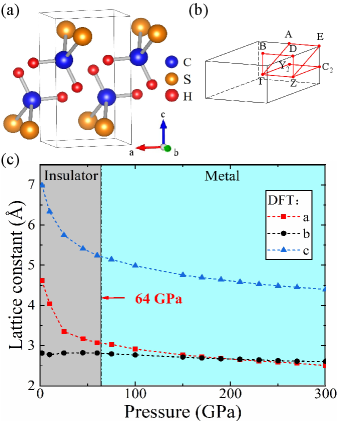
In the experiment of the room temperature superconductor C-S-H system, carbon and sulfur were mixed in a molar ratio of 1:1, and hydrogen was introduced under a certain pressure for reaction[42]. Because the material structure is unknown yet, we started to search for the possible stable structures by fixing the ratio of C : S = 1:1. Though many proposed C-S-H structures are unstable in the calculations, we obtained a stable structure C2S2H4 which contains 8 atoms in the primitive cell. The C2S2H4 at 300 GPa belongs to the monoclinic crystal with the space group of (No. 11). The optimized lattice constants are Å, Å, and Å with lattice angles of , , and as shown in Fig. 1(a). The pressure dependent lattice constants of C2S2H4 is plotted in Fig. 1(c). It is noted that the lattice constants and increase in a similar trend with the decrease of pressure, while slightly changes. The lattice constants of C2S2H4 at normal pressure become Å, Å, and Å, and the lattice angles are , , and . The change of C2S2H4 crystal structure will dramatically affect its electronic and many other properties.
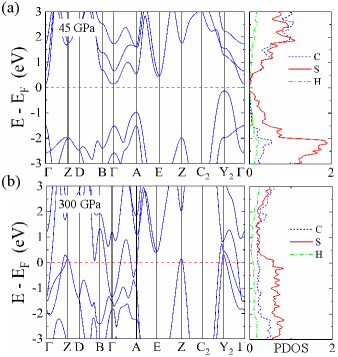
In Fig. 2, we plot the electron band structures and projected density of states (PDOS) at two representative pressures of 45 and 300 GPa. We find that there is an energy gap of 0.283 eV in C2S2H4 at 45 GPa, while it disappears at 300 GPa, which indicates the existence of the phase transition between insulator and metal as the change of pressure. In fact, we find that the critical pressure of insulator-metal phase transition is 64 GPa , as indicated in Fig. 1(c). In addition, it is noted that the DOS near Fermi level at 300 GPa mainly comes from the contribution of S atoms.
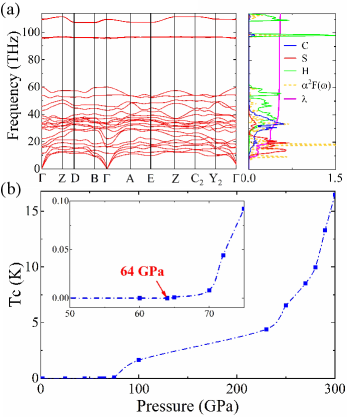
The metallicity of C2S2H4 at 300 GPa allows to investigate its possible superconductivity. Fig 3(a) gives the phonon spectra along high-symmetry paths ----------. There is no imaginary frequency mode in phonon spectra, indicating the dynamic stability of C2S2H4. Meanwhile, the phonon density of states (PhDOS) in Fig. 3(a) shows that S atoms vibrate at low frequency from 10 to 20 THz, C atoms vibrate around 30 THz, and H atoms vibrate at relative high frequency. Based on Migdal-Eliashberg theory [43, 44], the Eliashberg spectral function , and the cumulative frequency-dependent EPC of C2S2H4 at 300 GPa are calculated as also given in Fig. 3(a). It is obvious that S atoms located at low frequency make more contributions to the EPC, while H atoms at high frequency have little contribution to EPC.
Based on the BCS theory with the McMillan-Allen-Dynes approach [45, 46] and taking a typical value of the effective screened Coulomb repulsion constant = 0.1, we obtain the Tc of C2S2H4 at different pressures as plotted in Fig. 3(b). We find that with the increase of pressure, C2S2H4 does not become superconducting until 64 GPa because of the insulator-to-metal phase transition, and the Tc can reach 16.475 K at 300 GPa.
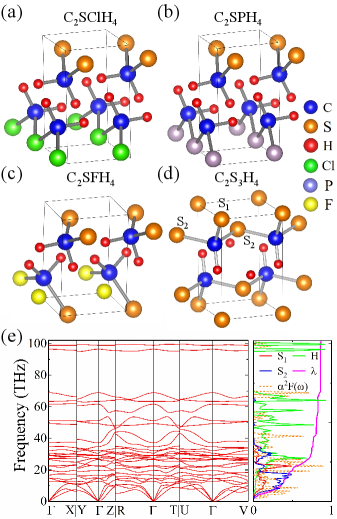
| C2S2H4 | C2SClH4 | C2SPH4 | |
| Tc (K) | 16.475 | 8.532 | 0.155 |
| 0.5504 | 0.5130 | 0.2712 | |
| C2SFH4 | C2S3H4 | ||
| Tc (K) | 3.613 | 47.439 | |
| 0.3986 | 0.8646 |
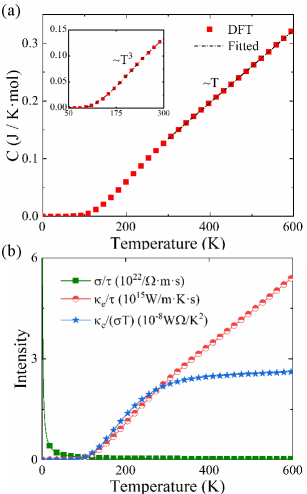
The temperature dependence of the electronic specific heat of C2S2H4 at 300 GPa is presented in Fig. 4(a). It is seen that the specific heat C(T) has distinct behaviors. When T50 K, C(T) is almost zero. At temperature region of 50 KT300 K, C(T)T3 (left upper inset), and at T300K, C(T)T. The result of C(T) suggests that below 300 K, the normal state shows a non-Fermi liquid behavior [47].
To further verify this observation, we have also studied the temperature dependence of Lorenz number defined by , as given in Fig. 4(b), as well as the electrical and thermal conductivity over relaxation time . It can be observed that at temperatures lower than 300 K, is not a constant, showing dramatical violation of Wiedemann-Franz law [48], while at higher temperature it shows almost a constant, exhibiting a Fermi liquid behavior. Therefore, C2S2H4 at 300 GPa shows a non-Fermi liquid behavior at temperatures below 300 K, implying that the interactions between electrons in the normal state play essential roles at low temperature.
Based on C2S2H4, we have designed four new structures as shown in Fig. 5: (a) electron doping by replacing a S atom with a Cl atom; (b) hole doping by replacing a S atom with a P atom; (c) replacing a S atom with a light element F atom; (d) adding a S atom to the vertex of the primitive cell of C2S2H4, where the added S atom is labeled as S1 and the original S atoms are labeled as S2. These four new structures are all demonstrated to be dynamically stable and exhibit superconductivity at 300 GPa (See details at Supplementary Information). TABLE 1 lists the Tc and EPC of C2S2H4 and the other four new superconductors. It is noted that the of C2S3H4 is much higher than that of C2S2H4, and Tc of the former is about three times larger than that of the latter. To uncover possible mechanism to enhance Tc, we compared the crystal structure, PhDOS, and of C2S2H4 and C2S3H4. For C2S2H4 in Fig. 1, one C atom connects two S and two H atoms. Whereas, one C atom in C2S3H4 connects three S atoms and one H atoms with another H atom originally connected to C atom isolated. The PhDOS in Fig. 5(e) shows that the isolated H atom contributes a new vibration peak within 25 and 30 THz, and the added S atom (S1) vibrates around 20 THz. The lowering vibration modes of S and H atoms greatly enhance the from 0.5504 of C2S2H4 to 0.8646 of C2S3H4, giving rise to a higher Tc of 47.439 K in C2S3H4. Our findings from C2S2H4 to C2S3H4 may provide a guide to find C-S-H superconductors with higher or even room temperature Tc experimentally in near future.
To conclude, we have searched for stable C-S-H structures with a C:S ratio of 1:1, and found a stable structure C2S2H4. The Tc at 300 GPa is calculated to be 16.475 K, which is mainly attributed to the low-frequency vibration of S atoms. With the applied pressure, an insulator-to-metal phase transition occurs, accompanied by the system into superconducting at 64 GPa. The electronic thermal conductivity and Lorentz number of C2S2H4 show a non-Fermi liquid behavior below 300K. In addition, we have designed four new stable structures on the basis of C2S2H4: C2SClH4, C2SPH4, C2SFH4, C2S3H4. Among them, C2S3H4 exhibts the highest Tc of 47.439 K. By analysis, we find that the added S atom in C2S3H4 changes the original bonding of C2S2H4, and contributs to new low-frequency vibration modes along with the isolated H atom. The molar ratio of C : S lower than 1:1 in the C-S-H systems may be favorable to enhance Tc, which will be useful not only to figure out the structure of the C-S-H material with room temperature Tc in the experiment, but also to find new superconductors with higher or even room temperature Tc in future.
This work is supported in part by the National Key R&D Program of China (Grant No. 2018YFA0305800), the Strategic Priority Research Program of the Chinese Academy of Sciences (Grant No. XDB28000000), the National Natural Science Foundation of China (Grant No.11834014), and Beijing Municipal Science and Technology Commission (Grant No. Z118100004218001). B.G. is supported in part by the National Natural Science Foundation of China (Grants No. 12074378 and No. Y81Z01A1A9 ), the Chinese Academy of Sciences (Grants No. YSBR-030, No. Y929013EA2 and No. E0EG4301X2), the University of Chinese Academy of Sciences (Grant No.110200M208), the Strategic Priority Research Program of Chinese Academy of Sciences (Grant No. XDB33000000), and the Beijing Natural Science Foundation((Grant No. Z190011).
References
- Kamerlingh Onnes [1911] H. Kamerlingh Onnes, Commun. Phys. Lab. Univ. Leiden, b 120 (1911).
- Bardeen et al. [1957] J. Bardeen, L. N. Cooper, and J. R. Schrieffer, Phys. Rev. 108, 1175 (1957).
- Bednorz and Muller [1986] J. G. Bednorz and K. A. Muller, Zeitschrift fur Physik B Condensed Matter 64, 189 (1986).
- Wu et al. [1987] M. K. Wu, J. R. Ashburn, C. J. Torng, P. H. Hor, R. L. Meng, L. Gao, Z. J. Huang, Y. Q. Wang, and C. W. Chu, Phys. Rev. Lett. 58, 908 (1987).
- Maeda et al. [1988] H. Maeda, Y. Tanaka, M. Fukutomi, and T. Asano, Jpn. J. Appl. Phys. 27, L209 (1988).
- Sheng and Hermann [1988] Z. Z. Sheng and A. M. Hermann, Nature 332, 55 (1988).
- Schilling et al. [1993] A. Schilling, M. Cantoni, J. D. Guo, and H. R. Ott, Nature 363, 56 (1993).
- Kamihara et al. [2008] Y. Kamihara, T. Watanabe, M. Hirano, and H. Hosono, J. Am. Chem. Soc. 130, 3296 (2008).
- Chen et al. [2008a] X. H. Chen, T. Wu, G. Wu, R. H. Liu, H. Chen, and D. F. Fang, Nature 453, 761 (2008a).
- Chen et al. [2008b] G. F. Chen, Z. Li, D. Wu, G. Li, W. Z. Hu, J. Dong, P. Zheng, J. L. Luo, and N. L. Wang, Phys. Rev. Lett. 100, 247002 (2008b).
- Ren et al. [2008] Z.-A. Ren, J. Yang, W. Lu, W. Yi, X.-L. Shen, Z.-C. Li, G.-C. Che, X.-L. Dong, L.-L. Sun, F. Zhou, and Z.-X. Zhao, Europhys. Lett. 82, 57002 (2008).
- Hebard et al. [1991] A. F. Hebard, M. J. Rosseinsky, R. C. Haddon, D. W. Murphy, S. H. Glarum, T. T. M. Palstra, A. P. Ramirez, and A. R. Kortan, Nature 350, 600 (1991).
- Haddon et al. [1991] R. C. Haddon, A. F. Hebard, M. J. Rosseinsky, D. W. Murphy, S. J. Duclos, K. B. Lyons, B. Miller, J. M. Rosamilia, R. M. Fleming, A. R. Kortan, S. H. Glarum, A. V. Makhija, A. J. Muller, R. H. Eick, S. M. Zahurak, R. Tycko, G. Dabbagh, and F. A. Thiel, Nature 350, 320 (1991).
- Rosseinsky et al. [1991] M. J. Rosseinsky, A. P. Ramirez, S. H. Glarum, D. W. Murphy, R. C. Haddon, A. F. Hebard, T. T. M. Palstra, A. R. Kortan, S. M. Zahurak, and A. V. Makhija, Phys. Rev. Lett. 66, 2830 (1991).
- Steglich et al. [1979] F. Steglich, J. Aarts, C. D. Bredl, W. Lieke, D. Meschede, W. Franz, and H. Schäfer, Phys. Rev. Lett. 43, 1892 (1979).
- Nagamatsu et al. [2001] J. Nagamatsu, N. Nakagawa, T. Muranaka, Y. Zenitani, and J. Akimitsu, Nature 410, 63 (2001).
- You et al. [2020] J.-Y. You, B. Gu, and G. Su, Phys. Rev. B 101, 184521 (2020).
- Tanaka et al. [2017] K. Tanaka, J. S. Tse, and H. Liu, Phys. Rev. B 96, 100502 (2017).
- Cui et al. [2020] W. Cui, T. Bi, J. Shi, Y. Li, H. Liu, E. Zurek, and R. J. Hemley, Phys. Rev. B 101, 134504 (2020).
- Sun et al. [2020] Y. Sun, Y. Tian, B. Jiang, X. Li, H. Li, T. Iitaka, X. Zhong, and Y. Xie, Phys. Rev. B 101, 174102 (2020).
- Cataldo et al. [2021] S. D. Cataldo, C. Heil, W. von der Linden, and L. Boeri, Phys. Rev. B 104, l020511 (2021).
- You et al. [2021] J.-Y. You, B. Gu, G. Su, and Y. P. Feng, Phys. Rev. B 103, 104503 (2021).
- Ashcroft [1968] N. W. Ashcroft, Phys. Rev. Lett. 21, 1748 (1968).
- Bonev et al. [2004] S. A. Bonev, E. Schwegler, T. Ogitsu, and G. Galli, Nature 431, 669 (2004).
- McMahon and Ceperley [2011] J. M. McMahon and D. M. Ceperley, Phys. Rev. Lett. 106, 165302 (2011).
- McMinis et al. [2015] J. McMinis, R. C. Clay, D. Lee, and M. A. Morales, Phys. Rev. Lett. 114, 105305 (2015).
- Wigner and Huntington [1935] E. Wigner and H. B. Huntington, J. Chem. Phys. 3, 764 (1935).
- Ashcroft [2004] N. W. Ashcroft, Phys. Rev. Lett. 92, 187002 (2004).
- Li et al. [2014] Y. Li, J. Hao, H. Liu, Y. Li, and Y. Ma, J. Chem. Phys. 140, 174712 (2014).
- Duan et al. [2014] D. Duan, Y. Liu, F. Tian, D. Li, X. Huang, Z. Zhao, H. Yu, B. Liu, W. Tian, and T. Cui, Sci. Rep. 4, 1 (2014).
- Drozdov et al. [2015] A. P. Drozdov, M. I. Eremets, I. A. Troyan, V. Ksenofontov, and S. I. Shylin, Nature 525, 73 (2015).
- Ge et al. [2016] Y. Ge, F. Zhang, and Y. Yao, Phys. Rev. B 93, 224513 (2016).
- Ge et al. [2020] Y. Ge, F. Zhang, R. P. Dias, R. J. Hemley, and Y. Yao, Materials Today Physics 15, 100330 (2020).
- Peng et al. [2017] F. Peng, Y. Sun, C. J. Pickard, R. J. Needs, Q. Wu, and Y. Ma, Phys. Rev. Lett. 119, 107001 (2017).
- Liu et al. [2017] H. Liu, I. I. Naumov, R. Hoffmann, N. W. Ashcroft, and R. J. Hemley, Proc. Natl. Acad. Sci. 114, 6990 (2017).
- Kwang-Hua [2020] C. R. Kwang-Hua, Mater Lett 271, 127743 (2020).
- Ye et al. [2018] X. Ye, N. Zarifi, E. Zurek, R. Hoffmann, and N. W. Ashcroft, J. Phys. Chem. C 122, 6298 (2018).
- Somayazulu et al. [2019] M. Somayazulu, M. Ahart, A. K. Mishra, Z. M. Geballe, M. Baldini, Y. Meng, V. V. Struzhkin, and R. J. Hemley, Phys. Rev. Lett. 122, 027001 (2019).
- Drozdov et al. [2019] A. P. Drozdov, P. P. Kong, V. S. Minkov, S. P. Besedin, M. A. Kuzovnikov, S. Mozaffari, L. Balicas, F. F. Balakirev, D. E. Graf, V. B. Prakapenka, E. Greenberg, D. A. Knyazev, M. Tkacz, and M. I. Eremets, Nature 569, 528 (2019).
- Hong et al. [2020] F. Hong, L. Yang, P. Shan, P. Yang, Z. Liu, J. Sun, Y. Yin, X. Yu, J. Cheng, and Z. Zhao, Chin. Phys. Lett. 37, 107401 (2020).
- Snider et al. [2021] E. Snider, N. Dasenbrock-Gammon, R. McBride, X. Wang, N. Meyers, K. V. Lawler, E. Zurek, A. Salamat, and R. P. Dias, Phys. Rev. Lett. 126, 117003 (2021).
- Snider et al. [2020] E. Snider, N. Dasenbrock-Gammon, R. McBride, M. Debessai, H. Vindana, K. Vencatasamy, K. V. Lawler, A. Salamat, and R. P. Dias, Nature 586, 373 (2020).
- Güntherodt [1980] G. Güntherodt, Le Journal de Physique Colloques 41, C5 (1980).
- Giustino [2017] F. Giustino, Rev. Modern Phys. 89, 015003 (2017).
- Allen and Dynes [1975] P. B. Allen and R. C. Dynes, Phys. Rev. B 12, 905 (1975).
- McMillan [1968] W. L. McMillan, Phys. Rev. 167, 331 (1968).
- Schofield [1999] A. J. Schofield, Contemp. Phys. 40, 95 (1999).
- Franz and Wiedemann [1853] R. Franz and G. Wiedemann, Annalen der Physik und Chemie 165, 497 (1853).