conformal duals of gauged MN models
Abstract
We suggest three new conformal dual pairs. First, we argue that the Minahan-Nemeschansky (MN) theory with a subgroup of the global symmetry conformally gauged with an vector multiplet and certain additional chiral multiplet matter resides at some cusp of the conformal manifold of an quiver gauge theory. Second, we argue that the MN theory with an subgroup of the global symmetry conformally gauged with an vector multiplet and certain additional chiral multiplet matter resides at some cusp of the conformal manifold of a conformal gauge theory. Finally, we claim that the MN theory with a subgroup of the global symmetry conformally gauged with an vector multiplet and certain additional chiral multiplet matter resides at some cusp of the conformal manifold of an conformal gauge theory. We argue for the dualities using a variety of non-perturbative techniques including anomaly and index computations. The dualities can be viewed as analogues of Argyres-Seiberg/Argyres-Wittig duals of the MN models. We also briefly comment on an version of the Schur limit of the superconformal index.
1 Introduction
Strongly coupled supersymmetric conformal field theories (SCFTs) can be engineered in a variety of ways. In particular they can be obtained as descriptions of an infra-red (IR) fixed points of renormalization group (RG) flows starting from a small relevant deformation of a weakly-coupled SCFT. The canonical examples in are the flows starting with SQCD in the conformal window. Strongly coupled SCFTs can be also engineered starting from a weakly coupled SCFT with a conformal manifold and tuning the couplings to be large. Canonical examples here include the SYM and a variety of conformal gauge theories. Moreover, a weakly coupled SCFT can have strongly-coupled loci, cusps, on the conformal manifold which can be alternatively described by weak gauging of a global symmetry of some strongly-coupled SCFT. A paradigmatic example of this is given by the Argyres-Seiberg duality Argyres:2007ws . In fact the discovery of these dualities triggered, starting with Gaiotto:2009we , an avalanche of new understandings of the dynamics of strongly-coupled SCFTs.
Conformal manifolds with minimal supersymmetry, as opposed to , in four dimensions have been much less studied. However, the existence of interesting conformal field theories with a manifold of exactly marginal couplings was established quite some time ago Leigh:1995ep (see e.g. Sohnius:1981sn ; Howe:1983wj ; Parkes:1984dh for earlier works), and the technology to identify such models is rather straightforward Green:2010da (see also Kol:2002zt ). One of the interesting features accompanying conformal manifolds with extended supersymmetry is that different regions of it might be describable by different looking weakly coupled, or partially weakly coupled, models as already mentioned above. In fact in Razamat:2019vfd numerous such dualities even for cases were suggested. The algorithm to search for such dual pairs used in Razamat:2019vfd is rather simple111This algorithm can be thought of as generalization of the search for dualities explored by Argyres and Wittig Argyres:2007tq .. Assuming the dual descriptions of a given model is conformal, that is no RG flow is involved, significantly restricts the space of possibilities. In particular, if one seeks for a conformal gauge theory description, the two conformal anomalies, and , completely fix the dimension of the gauge group and the dimension of the representation of the matter fields. This leaves only a finite set of possibilities to go over in the search for a dual description, which surprisingly often actually results in finding such a putative dual.
For the algorithm above to be applicable the model at hand should possess an preserving conformal manifold. However, many interesting SCFTs do not have such manifolds. Maybe some of the most well known examples are the Minahan-Nemeschansky (MN) SCFTs Minahan:1996fg ; Minahan:1996cj 222In recent years however some of these models have been constructed starting with weakly coupled gauge theories using RG flows Gadde:2010te ; Gadde:2015xta ; Agarwal:2018ejn ; Zafrir:2019hps .. However, one can use such SCFTs as components of larger models with a conformal manifold. A way to do so is to couple the conserved currents of a subgroup of the global symmetry to dynamical vector fields and add sufficient amount of matter so that the gauging, as well as any needed superpotential interactions, will be exactly marginal. One can do so for example for MN models preserving the supersymmetry Argyres:2007ws ; Argyres:2007tq . Once a conformal manifold appears, alongside comes the possibility that somewhere on it a dual weakly coupled description emerges. This was indeed the case for gaugings of MN models discussed in Argyres:2007ws ; Argyres:2007tq .
In the current note we will start from MN model and construct theories with conformal manifolds by gauging subgroups of the global symmetry, as in Argyres:2007ws ; Argyres:2007tq , but now preserving only supersymmetry. We will argue that after such a gauging somewhere on the conformal manifold a dual conformal gauge theory description emerges. For the case we will find a dual description as an quiver gauge theory while in the cases the dual will be a gauge theory with a simple gauge group333For other interesting dualities between gauge theories and constructions involving more general class models Gaiotto:2009we see for example Gadde:2013fma .. In each case we will test the dualities by studying properties which are invariants of the conformal manifold, like anomalies and superconformal indices. We suspect that there should be a powerful geometric interpretation (constructing the models starting from SCFTs on Riemann surfaces, e.g. for some examples see Gaiotto:2009we ; Benini:2009mz ; Bah:2012dg ; Gaiotto:2015usa ; Razamat:2016dpl ; Kim:2017toz ; Razamat:2018gro ; Pasquetti:2019hxf ; Razamat:2019ukg , or utilizing other string theory constructions) of the results presented here, as well as the ones reported in Razamat:2019vfd . We leave this aspect for future investigations.
2 Dual of MN theory with subgroup gauged
Let us consider the Minahan-Nemeschansky SCFT Minahan:1996fg . We consider the branching of representations of the symmetry to representations of its maximal subgroup such that , and further decompose to such that
| (1) |
Then we gauge the symmetry with the addition of six fundamentals, , and three two index traceless antisymmetrics, . Note that the imbedding indices of in and of in are , meaning that the anomaly is equal to , which is the same as the contribution of six free fundamental chiral fields of . In particular adding the fields above the one loop beta function will vanish. The global symmetry of the theory contains the symmetry coming from the SCFT. The comes from the enlarged R-symmetry of the superconformal algebra. Our assignment of charges is such that the moment map operators have charge while a dimension Coulomb branch operator has charge . For the not to be anomalous we assign charges to and to . We also have coming from the extra fields we add. Under , the fields have charge and charge .
The SCFT has conformal anomalies,
| (2) |
These are the anomalies which can be obtained from free vectors and free chiral fields using,
| (3) |
where is the number of free vectors (dimension of the gauge group) and is the number of free chiral superfields (dimension of the representation of the matter fields). We add to the model gauge fields of and additional six fundamentals and three two index traceless antisymmetric fields number of which is . The conformal anomalies of the theory are thus, and . If we are after a conformal dual of this model it has to have,
| (4) |
Having and assuming the dual is a conformal Lagrangian theory, we have only two candidate gauge groups, and . In fact we find a dual with the latter option. We suggest that the theory has a dual description in terms of an conformal quiver gauge theory depicted in Figure 1. This model has bi-fundamental fields between various gauge groups and fundamentals of a single gauge group. This matter content amounts to free chiral fields, guaranteeing that the conformal anomalies match. Each gauge group has six flavors ensuring the one loop gauge beta functions vanish, and we soon verify that indeed both models have non-trivial conformal manifold. We will match the indices of the theories in expansions of fugacities. In particular, it will imply equality of the number of relevant and marginal operators.
The conformal manifold
The Minahan-Nemeschansky SCFT has moment map operators in the adjoint of which decompose into as,
| (5) |
There are many marginal operators one can build and on a generic point of the conformal manifold all the symmetry is broken. Let us denote the operators in as and operators in as . Then the marginal operators are,
| (6) | |||
The operator is the dimension three Coulomb branch operator of the SCFT and denote representations under . To compute the dimension of the conformal manifold we need to analyze the Kähler quotient Green:2010da (see also Leigh:1995ep ; Kol:2002zt ), where are the marginal couplings and is the complexified global symmetry group. In our case the couplings are the ones for the operators in (6) and is . The Kähler quotient is not empty. For example times is not charged under any s and contains a component in . Taking it to symmetric sixth power we get singlet of all the symmetries. This deformation breaks the symmetry. Also the coupling breaks the symmetry444We will not be careful with the global structure of the groups in this note. to its subgroup, the to its , and furthermore locks the two groups to the diagonal. The is broken by the operators as follows , where the first arrow uses the embedding of the symmetry such that and in the second the is broken to its Cartan. This and the one acting on the antisymmetric are then locked to the diagonal. The combined effect of both of them is to break to . There is a 1d subspace that preserves the symmetry though a generic choice of these operators also breaks the , spanning an 8d subspace preserving only . Finally, we can turn on the rest of the marginal operators, and , which can be used to break all symmetries as well. This gives a dimensional conformal manifold on a generic point of which no symmetry is preserved.
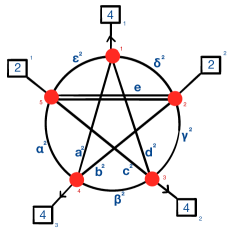
Let us analyze the conformal manifold on the quiver side. We have ten anomaly free abelian symmetries, which we denote as and (see Figure 1), and non-abelian symmetry at the free point. We have many marginal deformations and let us first list the operators which do not transform under by detailing their charges,
| (7) | |||
The are cubic operators winding between the th and th group, while the operators are cubic operators corresponding to triangles in the quiver. For the latter case, when is a Greek letter then these are triangles containing one bi-fundamental running along the circle (denoted by the Greek letter ) and two internal ones, while when is a Latin letter, then these are triangles containing one internal bi-fundamental (denoted by the Latin letter ) and two circle ones. We immediately note that,
| (8) |
is not charged under any abelian symmetries, does not transform under , and also contains an invariant of the three symmetries if we contract the indices with the epsilon symbols. Thus the conformal manifold is not empty. The effect of these operators is to break all abelian symmetries, save for , down to a single one which we denote, by abuse of notation, as (see Figure 2 for their charges in terms of ). Furthermore, the groups are all locked together and further broken. The minimal possible breaking of the groups is either to or , both happen along a subspace. A generic combination also break these symmetries to the Cartan. This gives a subspace along which a global symmetry is preserved.
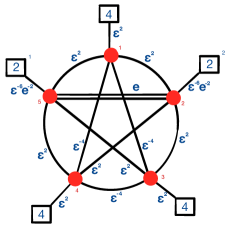
Let us continue to study the conformal manifold by going along the subspace preserving the , turning the marginal operators charged under the symmetries and only considering their charges under the symmetries preserved on this submanifold. We have the triplet of operators, which we denote as , and carry the charges: . These are the operators running between the th group and th group. We have three operators charged corresponding to three triangles including bi-fundamentals transforming under one the groups. Finally we have an operator charged which corresponds to an operator winding between the two groups. Note that it is easy to build invariants here. For example, is a singlet of (when we contract the indices with symbol) and is in the adjoint of and has charge , while say contains an adjoint of and has charge . Thus, contracting the two combinations we get a singlet. This deformation breaks , at least to the diagonal combination, breaks completely and identifies . In particular and , under the preserved symmetry, are in the , while the broken currents are in meaning that we get a five dimensional submanifold preserving . We also have an operator in the adjoint of which breaks it to the Cartan if turned on.
We can continue turning on marginal operators and breaking the symmetry further. The operator now are charged while is charged . In particular say taking is a singlet of all the remaining symmetries. These operators break the but preserve an . Here we decompose to such that . Some components of the operators will recombine with the conserved currents, some will contribute exactly marginal operators in the singlet of , and we will also get several operators in . Turning on these we can break to a diagonal and get several marginal operators in adjoint of it. Turning on one of the adjoints we can break the symmetry to the Cartan while turning on the rest we completely break the symmetry. All in all we break the symmetry completely on the conformal manifold. Thus the dimension of the manifold is the number of marginal operators minus the currents which gives us dimensional conformal manifold.
The supersymmetric index
The index in both duality frames is given by (for definitions of the index see Appendix A),
| (9) | |||
On the side of the duality the index can be computed using either the construction of Gadde:2010te ; Gadde:2015xta or the Lagrangian of Zafrir:2019hps . Moreover, as on the quiver side we have a rank five gauge theory making the evaluation of the index computationally intense, one can take the Schur limit of the index, even though the theory is only , to simplify computations. The limit is Razamat:2019vfd 555We thank C. Beem and C. Meneghelli for pointing out to us this relation to the Schur index. and then one can use the expressions for the index of SCFT using Schur polynomials Gadde:2011ik ; Gadde:2011uv ,
Here are the fugacities for the maximal subgroup of , and are the lengths of the Young tableaux defining representations of , and are the corresponding Schur polynomials. Then we define the single letter partition function of the extra fields on the side of the duality to be,
| (11) |
giving the index,
| (12) | |||
Here by we denote the invariant, Haar, measure. On the quiver side of the duality the contribution of the matter is,
| (13) | |||
with the index given by,
| (14) |
Both indices can be evaluated to rather high order to give , and explicitly,
| (15) | |||
We thus have compelling evidence that in fact the gauging of the MN theory is conformally dual to the quiver theory.
3 Dual of MN theory with subgroup gauged
Our second example of a duality has on one side an conformal gauge theory with a weak coupling limit, while the other contains an intrinsically strongly interacting part, which here is the rank MN theory. The gauge theory side has gauge group , three chiral fields in the traceless second rank antisymmetric representation and twelve chiral fields in the fundamental representation. With this matter content the one loop beta function vanishes. The theory has a non-anomalous global symmetry of . Under the symmetry the antisymmetric fields have charge and the fundamental fields have charge . The model has classically marginal operators made from a contraction of the antisymmetric and two fundamental chirals. This marginal operator is in the of and is uncharged under . As we shall show there is a non-trivial Kähler quotient, and so by the arguments of Leigh:1995ep ; Green:2010da , it exists as an SCFT with a conformal manifold containing the weak coupling point. It is possible to show that the can be completely broken on the conformal manifold leading to a dimensional conformal manifold, on a generic point of which only the is preserved. The theory has chiral operators of dimension given by the symmetric invariant of the antisymmetric chiral fields, transforming in the of and with charge under , and the antisymmetric invariant of the fundamental chiral fields, transforming in the of and with charge under .
The dual side is an gauging of the rank one SCFT with global symmetry with four chiral fields in the doublet representation for the . As the SCFT provides an effective number of eight chiral doublets for the beta function Argyres:2007ws , the latter vanishes. The theory has a global symmetry. Here the is the symmetry rotating the doublets and is the commutant of inside . The abelian symmetry is the anomaly free combination of the acting on the four doublets and , which is the commutant of the in the . Using the duality in Argyres:2007ws , it is straightforward to show that under this symmetry, which by abuse of notation we will denote , the doublets have charge where we have normalized as before, such that the moment map operators of the SCFT have charge .
We have relevant operators of dimension two given by the moment maps of the SCFT which transform in the . After the gauging these decompose to according to . In particular, we have the gauge variant operators, which can be made into a dimension three gauge invariant operators via a contraction with the chiral doublets. This gives a classically marginal operator in the . Additionally, as the moment map operators carry charge under the non-anomalous and the chiral doublets carry charge , it is uncharged under . As we shall show there is a non-trivial Kähler quotient, and so again it follows that this theory exists as an SCFT with a conformal manifold containing the weak coupling point of the . It is possible to show that the global symmetry can be completely broken on the conformal manifold leading to a dimensional conformal manifold, on a generic point of which only is preserved. The theory has dimension two operators, of which are given by the moment map operators associated with the and are in the of and have charge . The remaining operators come from the antisymmetric invariant of the doublets, transform in the of and carry charge under . Note that as the did not originate from an theory, it does not have moment map operators.
The SCFT has conformal anomalies,
| (16) |
These are the anomalies which can be obtained from free vectors and free chiral fields. We add to the model the gauge fields associated with the gauge group and four chiral fields in the doublet representation of , giving extra chiral fields. The conformal anomalies of the theory are thus, and . If we are after a conformal dual of this model it has to have,
| (17) |
Having and assuming the dual is a conformal Lagrangian theory we have only one candidate gauge group, , and we find such a dual mentioned above. This model has fundamental fields and three tracelss two index antisymmetric fields. This matter content amounts to free chiral fields, guaranteeing that the conformal anomalies match.
So far we have seen that both theories exist as interacting SCFTs with a conformal manifold and have the same conformal anomalies. We have also seen that the dimension of the conformal manifold, generically preserved global symmetry and relevant operators all match between the two theories. This prompts us to propose that these two theories are in fact dual and share the same conformal manifold. The global symmetry at the weak coupling point differs, but this can easily be accounted for as most of the global symmetry is broken when moving on the conformal manifold. The symmetry is the only part that is never broken and so must match between the two theories. We next present evidence for our claim.
Anomalies
We begin by comparing the ’t Hooft anomalies of the two theories. Only anomalies for symmetries that are preserved along a path on a conformal manifold connecting the two theories must match. Furthermore, only the flavor and are preserved on generic points and so these must match and we shall compare only these for now. The gauge theory contains vector multiplets, chiral fields with charge and free R-charge, and chiral fields with charge and free R-charge. From this data, all anomalies involving the flavor and can be calculated.
For the dual side, it is convenient to use the duality of Argyres:2007ws . It implies that the rank one SCFT has the same anomalies as vector multiplets, chiral fields with charge and free R-charge, and chiral fields with charge and free R-charge. Additionally, we have the with the four chiral doublets which contributes vector multiplets and chiral fields with charge and free R-charge. Overall we find the same effective matter content as the gauge theory and so all anomalies involving and will match.
Superconformal index
We can next match the superconformal index. It is not hard to compute it for the gauge theory finding,
| (18) | |||||
Here we use for the fugacity and we have only refined with respect to symmetries that are preserved generically on the conformal manifold. For the dual side, we utilize the index of the SCFT computed in Agarwal:2018ejn . Using it we find result exactly matching with (18). Here also we can compute the superconfomal index in the Schur limit on both sides to high order in an expansion in fugacities. To compute the Schur index we set and as before666Note that since is preserved on the conformal manifold one can utilize various limits of the index discussed in Gadde:2011uv . Let us here comment on the Coulomb limit. It is convenient to assign R charge to chiral fields with charge and R-charge to fields with charge . This assignment is non anomalous. The Coulomb limit is , while in the notations of this footnote, and it is easy to compute. On the side the SCFT contributes a factor of coming from the dimension four Coulomb branch operator, while the gauging contributes . On the gauge theory side the only contributions come from fields in the and we have . The two dual indices manifestly and non-trivially match.. To compute this result we first use Gadde:2011ik ; Gadde:2011uv to write the Schur index of the SCFT as,
Here are fugacities for two symmetries and is a fugacity for an . The appears in the decomposition of to , while the two appear in the decomposition of . The integers label the Young tableaux associated to representations of , and are the Schur polynomials for . Then we define the single letter partition function of the extra fields on the side of the duality to be,
| (20) |
giving the index,
On the quiver side of the duality the contribution of the matter is,
with the index given by,
| (21) |
In both duality frames we obtain that it is equal to,
| (22) | |||
Structure of the conformal manifold
Finally, we can study the structure of the conformal manifold in more detail. Specifically, we consider whether it may be possible to connect the two theories through a path in the conformal manifold preserving more than the flavor symmetry. For this we need to better examine the conformal manifold of the two theories. We shall start with the frame with the SCFT. Here the marginal operators are in the of the global symmetry. First, as the has a non-trivial quartic fully antisymmeric invariant, there is at least one exactly marginal combination. Say we insert it into the superpotential, then the symmetry would be reduced to the subgroup keeping that element fixed, that is to a subgroup of under which the contains a singlet.
Going over the list of subgroups, we find the following solution. We break to its subgroup such that , to its subgroup such that and we identify the two factors. Under this breaking we have that:
| (23) |
and there is indeed a singlet. Additionally the conserved currents of decompose as:
| (24) | |||||
| (25) |
As is broken to by the deformation, the additional conserved currents must be eaten by marginal operators. Examining (23), we see that we indeed have superpotential terms with the correct charges to merge with the conserved currents to form long multiplets. These superpotential terms then become marginally irrelevant and so we are left with as the marginal operators. This suggests that there is a subspace on the conformal manifold along which the preserved symmetry is . Along that subspace, we have additional marginal operators in the . The relevant dimension two operators carry charges of
| (26) |
under the preserved global symmetry.
Next we turn to the gauge theory. Here the marginal operators are in the of the global symmetry. We can again show that there is subspace along which the global symmetry is broken to . For this we consider the embedding , and and take the diagonal . Under this subgroup we have that:
| (27) |
and there is indeed a singlet. We next need to consider the operators eaten by the broken currents, for which we need to consider the decomposition of the conserved currents:
| (28) | |||||
| (29) |
Again we find that we have sufficient superpotential terms to eat the broken currents, and we are left with: . Thus, we see that we indeed find a subspace along which a global symmetry is preserved777We can continue and break the symmetry completely by turning on the marginal operator in . In particular turning on this operator we can preserve along an additional locus a diagonal combination of the and subgroup of such that . Doing so the remaining marginal operators are in the of the preserved . Indeed we have a singlet and we can continue to break the further to the Cartan and then completely. All in all in the end we obtain dimensional conformal manifold.. Furthermore, the remaining marginal operators match those found in the other frame. Finally we note that the relevant dimension two operators carry charges of
| (30) |
under the preserved global symmetry. These indeed match those found in the other frame. Moreover it is also possible to check that the Schur indices refined with the fugacities agree in an expansion in . To perform this computation one should change the in (20) to of , the and the in (3) to and of respectively. Moreover, in the index of the SCFT we have two symmetries parametrized by and manifestly visible, and the is imbedded in these as,
| (31) | |||
Therefore, we conclude that it is possible that the two theories can be linked by going only on this subspace. If this is true then the anomalies involving the preserved global symmetry must also match. Indeed it is possible to show that they do. On the gauge theory side, we have as our basic fields five chirals in the with charge and free R-charge and four chirals in the with charge and free R-charge. On the side we have as our basic fields two chirals in the with charge and free R-charge and four chirals in the with charge and free R-charge, where we have used the duality of Argyres:2007ws to represent the anomalies of the rank SCFT in terms of free chiral fields. It is straightforward to show that indeed all the anomalies match.
4 Dual of MN theory with subgroup gauged
We consider yet another example where one side is an conformal gauge theory with a weak coupling limit, while the other contains an intrinsically strongly interacting part, which here is the rank MN theory Minahan:1996cj . The gauge theory side has gauge group , ten chiral fields in the spinor representation and five chiral fields in the fundamental representation. With this matter content the gauge one loop beta function vanishes. The theory has a non-anomalous global symmetry of , and also has classically marginal operators made from a contraction of the vector and two spinor chirals. We assign charge to the spinors and charge to the vectors. This marginal operator, , is in the of (with being the index and and the indices). It is possibe to show that this operator has a non-trivial Kähler quotient, and so this theory exists as an SCFT with a conformal manifold containing the weak coupling point. We can decompose into such that,
| (32) |
where are the fugacities of the . Identifying the with the (one over the square root of) Cartan of and turning on only the operators which are invariant under this we get a one dimensional sub-locus of the conformal manifold. To see that we decompose all the marginal operators and conserved currents into representations of to obtain,
| (33) | |||
Subtracting the conserved currents from the marginal operators we obtain,
| (34) |
which corresponds to one exactly marginal operator preserving and a collection of marginal operators which break these symmetries. We can continue to break the symmetry gradually. Turning on any one of the charged marginal operators will break the two involved groups to the diagonal and will break one combination of the symmetries. Turning on the five operators (where we identify indices ) we break all the symmetries to the diagonal and break all the symmetries (except for ). We are also left with many adjoint operators of the diagonal , turning one of which we break the to the Cartan, and then turning additional operators charged under the Cartan we can break the symmetry completely. In the end the has been completely broken on the conformal manifold leading to a dimensional conformal manifold, on a generic point of which only a is preserved. The theory has chiral operators of dimension given by the symmetric invariant of the vector chiral fields, transforming in the of and with charge under , and the symmetric invariant of the spinor chiral fields, transforming in the of and with charge under .
The dual side is an gauging of the rank one SCFT with global symmetry with six chiral fields in the fundamental representation for the . As the SCFT provides an effective number of twelve fundamental chirals for the beta function, the latter vanishes. The theory has a global symmetry. Here the is the symmetry rotating the doublets and is the commutant of inside . The group is the anomaly free combination of the acting on the four doublets and , which is the commutant of the in the . It is straightforward to show that under the doublets have charge where we have normalized , as before, such that the moment map operators of the SCFT have charge .
We have relevant operators of dimension two given by the moment maps of the SCFT which transform in the . After the gauging these decompose to according to
In particular, we have the gauge variant operators, which can be made into a dimension three gauge invariant operators via a contraction with the chiral doublets. This gives a classically marginal operator (with the being the index) in the . Additionally, as the moment map operators carry charge under the non-anomalous and the chiral fundamentals carry charge , it is uncharged under the . We note that as contains a singlet in its sixth completely antisymmetric power, taking contains a singlet meaning the Kähler quotient is not empty. There are different possible choices of symmetries to preserve, leading to many different subspaces. One choice is to break the symmetry to , where we break and . The is then the diagonal one and the is a combination of the various commtants. It is possible to show, with methods similar to those previously used, that this leads to a subspace preserving global symmetry. We can then continue and further break all the part of the global symmetry, leading to a dimensional conformal manifold, on a generic point of which only is preserved.
The theory has dimension two operators, of which are given by the moment map operators associated with the and are in the of and have charge . The remaining operators come from the antisymmetric invariant of the doublets, transform in the of and carry charge under the . Note that as the did not originate from an theory, it does not have moment map operators.
The SCFT has conformal anomalies,
| (35) |
These are the anomalies which can be obtained from free vectors and free chiral fields. We add to the model gauge fields of and additional six fundamental fields, the number of which is . The conformal anomalies of the theory are thus, and . If we are after a conformal dual of this model it has to have,
| (36) |
Having and assuming the dual is a conformal Lagrangian theory we have several options for a candidate gauge group: , , , , . We find such a dual mentioned above with a gauge group. This model has vector fields and spinor fields. This matter content amounts to free chiral fields, guaranteeing that the conformal anomalies match.
We can also easily compare the ’t Hooft anomalies for the symmetry preserved on a generic point of the conformal manifold. The theory has free fields with charge coming from the spinors and free fields with charge coming from the vectors. To figure out the anomalies of the SCFT we use an Argyres-Wittig duality Argyres:2007tq . The SCFT with a subgroup of gauged with an vector multiplet is dual to a gauge theory with a half-hypermultiplet in and eleven half-hypermultiplets in the . This means that the SCFT has the same anomalies as free chiral fields with charge and free chiral fields with charge . We add more free fields with charge (the fundamentals of ) when we gauge the to obtain our model. Thus in total we have free fields with charge and free fields with charge . We thus get perfect agreement between the two sides of the duality.
So far we have seen that both theories exist as interacting SCFTs with a conformal manifold. We have also seen that the dimension of the conformal manifold, generically preserved global symmetry, anomalies for these symmetries, and relevant operators all match between the two theories. This prompts us to propose that these two theories are in fact dual and share the same conformal manifold. The global symmetry at the weak coupling point differs, but this can easily be accounted for as most the global symmetry is broken when moving on the conformal manifold. The group is the only part that is never broken and so must match between the two theories. We next compare the indices of the two theories presenting additional evidence for our claim.
Here, the full index of the SCFT is not yet determined. However one can compute the Schur limit of the index. We use Gadde:2011ik ; Gadde:2011uv to write the Schur index of the SCFT as888Here, as in the case, as is preserved we can compute other limits of the index, and in particular the Coulomb limit. On the side we have a contribution from the dimension six Coulomb branch operator and a contribution from the gauging . While on the side the only fields which contribute are the vectors, and we get . The two indices manifestly match. ,
| (37) | |||
Here we only refine the index with the fugacities for the symmetry we are going to gauge. Note that the construction of the index has manifest subgroup of and is imbedded in the such that followed by with . As before the are the lengths of the rows of the Young tableaux defining representations and are the corresponding Schur polynomials. Then we define the single letter partition function of the extra fields on the side of the duality to be,
| (38) |
giving the index,
On the quiver side of the duality the contribution of the matter is,
with the index given by,
| (39) |
Let us write explicitly the characters of represnetations of for completeness,
| (40) |
The result of the computation in the two duality frames is equal and is given by,
| (41) | |||
We thus have gathered a compelling collection of evidence that the two theories are indeed dual to each other.
Acknowledgments
We are grateful to Evyatar Sabag for relevant discussions. The research of SSR is supported by Israel Science Foundation under grant no. 2289/18, by I-CORE Program of the Planning and Budgeting Committee, and by BSF grant no. 2018204. GZ is supported in part by the ERC-STG grant 637844-HBQFTNCER and by the INFN.
Appendix A Schur index
Let us discuss basic definitions of the supersymmetric index and its Schur limit specification. We use the standard definitions of the index Kinney:2005ej ; Romelsberger:2005eg ; Dolan:2008qi which can be found in e.g. Rastelli:2016tbz . Concretely the index is the trace over the Hilbert space of a theory quantized on and it depends on two parameters, and , and on a set of fugacities for global symmetries,
| (42) |
Here are the Cartan generators of the two isometries of the sphere and is the R-charge assignment. The group is the global symmetry group, are fugacities of the Cartan maximal torus of , and are the charges under these abelian symmetries. The states contributing to the index satisfy, , with being the scaling dimension. This combination picks up one of the four supercharges relative to which the index is computed.
The index can be computed by projecting on gauge invariant states the contributions of chiral and vector fields. The contributions of the fields can be written using the plethystic exponent,
| (43) |
The index of the chiral field of R-charge and represnetation under symmetry group is given by,
| (44) |
while the contribution of the vector amounts to,
| (45) |
where is the gauge group and is the character of the adjoint representation. Note that the numerator in the plethystic exponent comes from zero modes of fields, bosons with plus sign and fermions with minus sign, while the denominator comes from two derivatives which contribute to the index. The argument of the plethystic exponent is usually called the single letter index.
Note that computing the plethystic exponent for the chiral field the result will be a double infinite product giving rise to an elliptic Gamma function Dolan:2008qi . However, if the representation is (pseudo)real, , then we can choose the parameters and to be related as,
| (46) |
and then additional cancelation between fermions and bosons occur leading to the index of the chiral to be,
| (47) |
Note that this is precisely the expression for the Schur index Gadde:2011ik ; Gadde:2011uv of an half-hypermultiplet. In the case the extra cancelations in the index can be explained by the index being invariant under additional supercharge. For the case such cancelation will not in general happen if we have fields of different R-charges and non (pseudo)real representations. However, in the conformal Lagrangian theories such that all the R-charges are free, and in particular are the same, the cancelations in the limit can happen if all the representations are (pseudo)real, as is the case in all the examples in this paper. In these cases (46) becomes and we will refer to the limit as Schur index. Note that Lagrangian theories then are just a special case of this class of theories.
The single letter index of the free vector multiplet becomes,
| (48) |
and it formally looks as that of an vector multiplet (the first term) and the inverse contribution of an adjoint chiral field. If the theory happens to be then it will also contain a chiral field in adjoint representation of the gauge group, the contribution of which will cancel with the latter term. If one is to compute the Schur index of a conformal theory constructed by an conformal gauging of an component with possibly additional matter, as is done in this paper, one can first compute the Schur indices of the components and then combine them together. This is useful as, though for most theories a Lagrangian is not known yet, we do know for large classes of them the value of the Schur index Gadde:2011ik ; Gadde:2011uv , and this class of theories was enlarged recently by the discovery of the relation between Schur indices and chiral algebras Beem:2013sza . As with the Schur index also the version can be expressed using functions,
| (49) |
Using the fact that the representations we allow are (pseudo)real, the non-zero weights come in pairs. We thus can split the non zero weights arbitrarily into a group of “positive” and “negative” roots, and , such that if then . We denote the number of zero weights by . Then the index of the chiral field is,
| (50) |
The index of a gauge theory with group can be written then as,
Here is the Weyl group of , the parametrize the maximal torus with spanning the space of roots, and is the set of positive roots. As the index can be written in terms of objects with interesting properties, see e.g. Razamat:2012uv ; Beem:2017ooy ; Cordova:2016uwk , it is tempting to speculate that also the Schur index has to do something with CFTs/chiral algebras.
References
- (1) P. C. Argyres and N. Seiberg, “S-duality in N=2 supersymmetric gauge theories,” JHEP 12 (2007) 088, arXiv:0711.0054 [hep-th].
- (2) D. Gaiotto, “N=2 dualities,” JHEP 08 (2012) 034, arXiv:0904.2715 [hep-th].
- (3) R. G. Leigh and M. J. Strassler, “Exactly marginal operators and duality in four-dimensional N=1 supersymmetric gauge theory,” Nucl. Phys. B447 (1995) 95–136, arXiv:hep-th/9503121 [hep-th].
- (4) M. F. Sohnius and P. C. West, “Conformal Invariance in N=4 Supersymmetric Yang-Mills Theory,” Phys. Lett. 100B (1981) 245.
- (5) P. S. Howe, K. S. Stelle, and P. C. West, “A Class of Finite Four-Dimensional Supersymmetric Field Theories,” Phys. Lett. 124B (1983) 55–58.
- (6) A. Parkes and P. C. West, “Finiteness in Rigid Supersymmetric Theories,” Phys. Lett. 138B (1984) 99–104.
- (7) D. Green, Z. Komargodski, N. Seiberg, Y. Tachikawa, and B. Wecht, “Exactly Marginal Deformations and Global Symmetries,” JHEP 06 (2010) 106, arXiv:1005.3546 [hep-th].
- (8) B. Kol, “On conformal deformations,” JHEP 09 (2002) 046, arXiv:hep-th/0205141 [hep-th].
- (9) S. S. Razamat and G. Zafrir, “ conformal dualities,” JHEP 09 (2019) 046, arXiv:1906.05088 [hep-th].
- (10) P. C. Argyres and J. R. Wittig, “Infinite coupling duals of N=2 gauge theories and new rank 1 superconformal field theories,” JHEP 01 (2008) 074, arXiv:0712.2028 [hep-th].
- (11) J. A. Minahan and D. Nemeschansky, “An N=2 superconformal fixed point with E(6) global symmetry,” Nucl. Phys. B482 (1996) 142–152, arXiv:hep-th/9608047 [hep-th].
- (12) J. A. Minahan and D. Nemeschansky, “Superconformal fixed points with E(n) global symmetry,” Nucl. Phys. B489 (1997) 24–46, arXiv:hep-th/9610076 [hep-th].
- (13) A. Gadde, L. Rastelli, S. S. Razamat, and W. Yan, “The Superconformal Index of the SCFT,” JHEP 08 (2010) 107, arXiv:1003.4244 [hep-th].
- (14) A. Gadde, S. S. Razamat, and B. Willett, “”Lagrangian” for a Non-Lagrangian Field Theory with Supersymmetry,” Phys. Rev. Lett. 115 no. 17, (2015) 171604, arXiv:1505.05834 [hep-th].
- (15) P. Agarwal, K. Maruyoshi, and J. Song, “A “Lagrangian” for the E7 superconformal theory,” JHEP 05 (2018) 193, arXiv:1802.05268 [hep-th].
- (16) G. Zafrir, “An N=1 Lagrangian for the rank 1 superconformal theory,” arXiv:1912.09348 [hep-th].
- (17) A. Gadde, K. Maruyoshi, Y. Tachikawa, and W. Yan, “New N=1 Dualities,” JHEP 06 (2013) 056, arXiv:1303.0836 [hep-th].
- (18) F. Benini, Y. Tachikawa, and B. Wecht, “Sicilian gauge theories and N=1 dualities,” JHEP 01 (2010) 088, arXiv:0909.1327 [hep-th].
- (19) I. Bah, C. Beem, N. Bobev, and B. Wecht, “Four-Dimensional SCFTs from M5-Branes,” JHEP 06 (2012) 005, arXiv:1203.0303 [hep-th].
- (20) D. Gaiotto and S. S. Razamat, “ Theories of Class ,” JHEP 07 (2015) 073, arXiv:1503.05159 [hep-th].
- (21) S. S. Razamat, C. Vafa, and G. Zafrir, “4d from 6d (1, 0),” JHEP 04 (2017) 064, arXiv:1610.09178 [hep-th].
- (22) H.-C. Kim, S. S. Razamat, C. Vafa, and G. Zafrir, “E‐String Theory on Riemann Surfaces,” Fortsch. Phys. 66 no. 1, (2018) 1700074, arXiv:1709.02496 [hep-th].
- (23) S. S. Razamat and G. Zafrir, “Compactification of 6d minimal SCFTs on Riemann surfaces,” Phys. Rev. D98 no. 6, (2018) 066006, arXiv:1806.09196 [hep-th].
- (24) S. Pasquetti, S. S. Razamat, M. Sacchi, and G. Zafrir, “Rank E-string on a torus with flux,” SciPost Phys. 8 (2020) 014, arXiv:1908.03278 [hep-th].
- (25) S. S. Razamat and E. Sabag, “Sequences of SCFTs on generic Riemann surfaces,” JHEP 01 (2020) 086, arXiv:1910.03603 [hep-th].
- (26) A. Gadde, L. Rastelli, S. S. Razamat, and W. Yan, “The 4d Superconformal Index from q-deformed 2d Yang-Mills,” Phys. Rev. Lett. 106 (2011) 241602, arXiv:1104.3850 [hep-th].
- (27) A. Gadde, L. Rastelli, S. S. Razamat, and W. Yan, “Gauge Theories and Macdonald Polynomials,” Commun. Math. Phys. 319 (2013) 147–193, arXiv:1110.3740 [hep-th].
- (28) J. Kinney, J. M. Maldacena, S. Minwalla, and S. Raju, “An Index for 4 dimensional super conformal theories,” Commun. Math. Phys. 275 (2007) 209–254, arXiv:hep-th/0510251 [hep-th].
- (29) C. Romelsberger, “Counting chiral primaries in N = 1, d=4 superconformal field theories,” Nucl. Phys. B747 (2006) 329–353, arXiv:hep-th/0510060 [hep-th].
- (30) F. A. Dolan and H. Osborn, “Applications of the Superconformal Index for Protected Operators and q-Hypergeometric Identities to N=1 Dual Theories,” Nucl. Phys. B818 (2009) 137–178, arXiv:0801.4947 [hep-th].
- (31) L. Rastelli and S. S. Razamat, “The supersymmetric index in four dimensions,” J. Phys. A50 no. 44, (2017) 443013, arXiv:1608.02965 [hep-th].
- (32) C. Beem, M. Lemos, P. Liendo, W. Peelaers, L. Rastelli, and B. C. van Rees, “Infinite Chiral Symmetry in Four Dimensions,” Commun. Math. Phys. 336 no. 3, (2015) 1359–1433, arXiv:1312.5344 [hep-th].
- (33) S. S. Razamat, “On a modular property of N=2 superconformal theories in four dimensions,” JHEP 10 (2012) 191, arXiv:1208.5056 [hep-th].
- (34) C. Beem and L. Rastelli, “Vertex operator algebras, Higgs branches, and modular differential equations,” JHEP 08 (2018) 114, arXiv:1707.07679 [hep-th].
- (35) C. Cordova, D. Gaiotto, and S.-H. Shao, “Infrared Computations of Defect Schur Indices,” JHEP 11 (2016) 106, arXiv:1606.08429 [hep-th].